



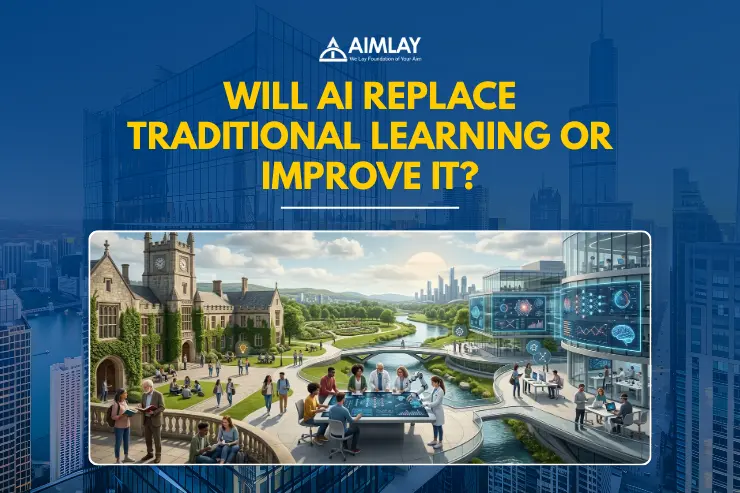
The rise of Artificial Intelligence in Education is sparking one of the biggest debates of our time Will AI replace traditional learning, or will it make education better than ever? From intelligent tutoring systems to adaptive learning technology, AI is no longer a futuristic concept it is sitting inside classrooms, homes, and smartphones today. Whether you are an educator, parent, or lifelong learner, understanding where AI fits within the learning ecosystem is critical.
This blog breaks down the real comparison between AI vs traditional education, what it means for students and teachers, and where the future of learning is truly headed.
Table of Content
• What Is Traditional Learning and Why Does It Still Matter?
• Can AI Replace Teachers?
• What Is AI Powered Learning and How Does It Work?
• AI vs Traditional Learning
• What Are the Real Benefits of AI in Education?
• What Is the Hybrid Learning Model and Why Is It the Future?
• Will AI Replace Traditional Learning?
• Conclusion
• Frequently Asked Questions
What Is Traditional Learning and Why Does It Still Matter?
Traditional learning refers to the conventional, classroom-based model of education structured curricular, face-to-face instruction, scheduled assessments, and human teachers guiding students through topics. For centuries, this model has been the backbone of civilization’s knowledge transfer.
Despite the digital age, traditional learning still holds immense value:
. Social development: Students learn collaboration, empathy, communication, and conflict resolution through real human interaction.
. Accountability structures: Fixed timetables and teacher oversight keep students on track.
. Holistic mentorship: A teacher doesn’t just deliver content they inspire, counsel, and nurture critical thinking.
. Moral and Emotional Education: Values, ethics, and emotional intelligence are naturally embedded in human-centered learning environments.
Traditional classrooms also offer irreplaceable cultural and community experiences. A teacher who shares a personal struggle, a group project that builds friendships, or a classroom debate that ignites passion. These are dimensions of education that no algorithm can replicate on its own.
Can AI Replace Teachers?
This is perhaps the most asked question in education today Can AI replace teachers? The short answer is no and here is why.
Teaching is not merely the transmission of information. It is a deeply human act of inspiration, motivation, and relationship-building. A great teacher reads the room, picks up on subtle signs of student distress, adjusts tone mid-lesson, and makes a struggling student feel seen and supported. These are qualities rooted in human-centered learning that AI, at least in its current form, simply cannot replicate.
What AI can do is dramatically amplify a teacher’s effectiveness. By handling routine tasks, grading, progress tracking, identifying weak areas AI gives teachers more time to do what they do best: connect with students on a human level.
Think of AI as a highly capable teaching assistant, not a replacement instructor. The role of the educator evolves from information-giver to learning coach and mentor arguably a more meaningful and impactful role than ever before.
What Is AI Powered Learning and How Does It Work?
AI-powered learning uses machine learning algorithms, natural language processing, and data analytics to deliver personalized, adaptive educational experiences. Instead of one teacher managing 30+ students with varying needs, AI can simultaneously tailor content, pacing, and assessments for every individual learner.
Key Technologies Driving AI in Education Include:
. Intelligent Tutoring Systems (ITS): Platforms like Carnegie Learning and Khan Migo use AI to identify knowledge gaps and offer targeted feedback in real time.
. Adaptive learning technology: Systems like Dream Box or Duolingo adjust lesson difficulty based on student performance data.
. Automated Grading and Assessment: AI can evaluate essays, quizzes, and even spoken responses, freeing teachers from repetitive tasks.
. Natural Language Processing Chatbots: Virtual learning assistants answer student questions 24/7 without requiring human availability.
. Predictive Analytics: Schools use AI to identify at-risk students early and intervene before failure occurs.
The promise of personalized education with AI is simple but powerful for every learner to get exactly what they need, when they need it, at the pace that suits them best.
AI vs Traditional Learning: A Head-to-Head Comparison
Here is a structured look at how AI and traditional learning compare across critical educational dimensions:
| Feature | Traditional Learning | AI-Powered Learning |
|---|---|---|
| Personalization | Limited — One Curriculum for All | High — Adapts to Each Learner’s Needs |
| Teacher Role | Central Instructor and Mentor | Facilitator and Guide |
| Pace | Fixed for the Whole Class | Self-Paced and Flexible |
| Availability | School Hours Only | 24/7 Access Anytime, Anywhere |
| Social Interaction | Rich Peer and Teacher Interaction | Minimal Human Interaction |
| Cost | High (Infrastructure, Staffing) | Scalable and Often Lower Cost |
| Emotional Support | Strong Empathy and Mentorship | Limited — Lacks Human Empathy |
| Data & Feedback | Periodic (Tests, Report Cards) | Real-Time, Continuous Feedback |
| Critical Thinking | Encouraged Through Discussion and Debate | Still Dependent on Human Facilitation |
| Scalability | Limited by Geography and Resources | Global and Highly Scalable |
This AI and traditional learning comparison reveals that neither model is flawless. The gap in emotional intelligence and social learning remains AI’s biggest weakness, while the inability to personalize at scale remains traditional education’s greatest limitation.
What Are the Real Benefits of AI in Education?
The benefits of AI in education extend beyond convenience. Here are the most impactful advantages:
1. True Personalization at Scale: Traditional classrooms struggle to serve students at different levels simultaneously. AI-driven adaptive learning technology customizes every student’s journey gifted learner can accelerate, while struggling students receive more targeted support without stigma.
2. Immediate, Actionable Feedback: Instead of waiting days for graded tests, students using intelligent tutoring systems get instant feedback that helps them correct mistakes while the material is still fresh in their minds.
3. Democratizing Access to Quality Education: A child in a rural village with internet access can receive the same quality of AI-enhanced instruction as a student in a top urban school. AI has the potential to be a great equalizer in global education.
4. Reducing Teacher Burnout: Administrative overload is one of the leading causes of teacher attrition. AI tools automate grading, attendance, reporting, and even lesson planning, restoring teachers’ time and energy.
5. Data-Driven Decision Making: School administrators and educators gain detailed insights into student performance trends, curriculum effectiveness, and early warning signs of disengagement enabling smarter, faster interventions.
6. Continuous Learning Beyond School Hours: With AI-enhanced learning platforms, education does not stop when the bell rings. Students can revisit lessons, ask questions, and practice skills at any hour of the day.
What Is the Hybrid Learning Model and Why Is It the Future?
The Hybrid Learning Model, with a blend of traditional human instruction and AI-powered tools, is increasingly recognized as the most balanced and effective approach to modern education.
Rather than choosing between AI vs traditional learning, the hybrid model combines the best of both:
AI handles: Personalized content delivery, automated assessments, progress tracking, and administrative tasks.
Teachers handle: Mentorship, complex discussions, ethical guidance, emotional support, and creative problem-solving facilitation.
Schools and universities already implementing hybrid models report higher student engagement, improved learning outcomes, and reduced teacher workload. Platforms like Google Classroom integrated with AI tools, or university LMS systems paired with intelligent tutoring, are early examples of this powerful synergy.
The hybrid learning model is not a compromise; it is an upgrade. It acknowledges that artificial intelligence in education works best as a collaborator, not a competitor.
Will AI Replace Traditional Learning?
To directly address the central question Will AI replace traditional learning?
Almost certainly not at least in the way many fears. What is more likely and already happening is a transformation of traditional education rather than its elimination.
The infrastructure of schooling, the irreplaceable bonds of teacher-student relationships, and the communal experience of shared learning are not made obsolete by AI. They are made more powerful when AI removes friction, inefficiency, and inequality from the process.
The real risk is not AI replacing teachers; it is institutions failing to adapt. Schools that resist AI in education risk leaving students underprepared for a workforce already saturated with AI tools. Educators who embrace AI-powered learning as a partner will thrive; those who see it purely as a threat may find themselves left behind. The future belongs to the hybrid learning model of human wisdom amplified by intelligent technology.
Conclusion
The discussion about intelligence and traditional learning is about how they can work. Artificial intelligence is a tool that makes learning more effective for students. It works best when it is used with the good things that human teachers do.
The future of education is about using intelligence and traditional learning together to help every student. The question is not whether artificial intelligence will change education. If educators and policymakers are ready to use artificial intelligence in a smart way.
Frequently Asked Questions
Will artificial intelligence completely replace learning?
No. Artificial intelligence will not replace learning. It can enhance and support the learning process, but it cannot replace the human aspects of education such as mentorship, critical thinking development, motivation, and emotional support. AI is best viewed as a tool that helps students learn more effectively.
Can artificial intelligence replace teachers in schools?
Artificial intelligence can assist with tasks such as content delivery, assessment, and personalized learning recommendations. However, it cannot replace the empathy, inspiration, guidance, and human connection that teachers provide. Educators remain essential to the learning experience.
What is the difference between AI-powered learning and traditional learning?
Traditional learning typically follows a fixed curriculum delivered by a teacher in a classroom setting. AI-powered learning uses intelligent algorithms to personalize content, learning pace, and feedback according to individual student needs, making the learning experience more adaptive and flexible.
What are the benefits of artificial intelligence in education?
AI offers several benefits, including personalized learning experiences, 24/7 access to educational support, faster feedback, reduced administrative workload for teachers, improved accessibility, and data-driven insights that help educators support student success more effectively.
What is a hybrid learning model?
A hybrid learning model combines traditional teaching methods with AI-powered educational tools. AI helps personalize learning and automate routine tasks, while teachers focus on mentoring, fostering critical thinking, and providing emotional support. This approach combines the strengths of both technology and human instruction.
