



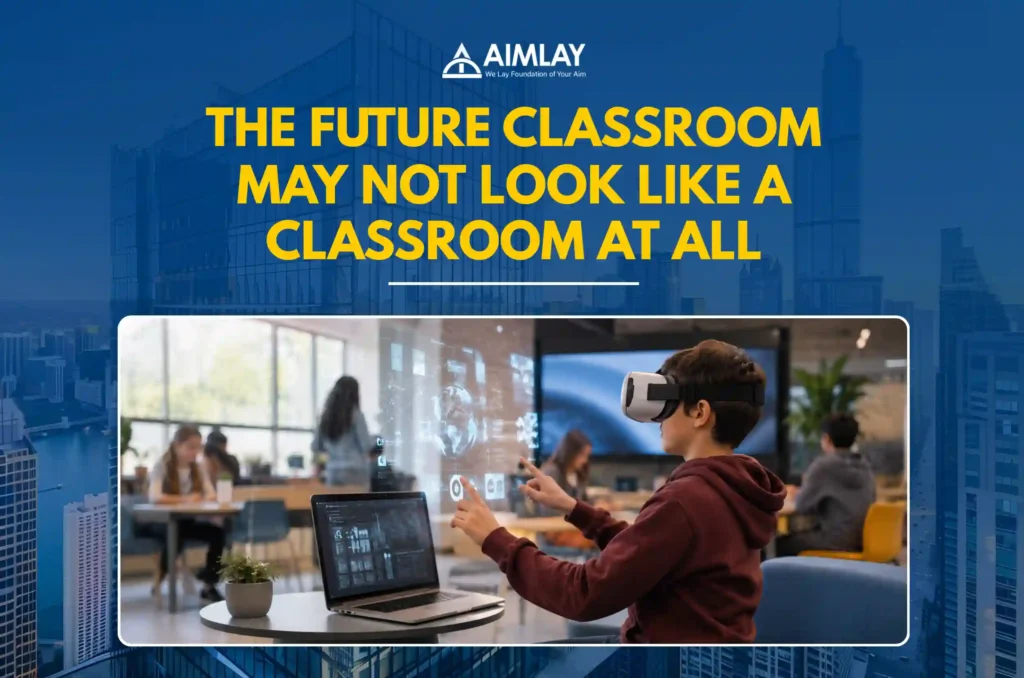
In the coming years, the ways in which people teach and learn are changing significantly. As physical rooms with four walls, fixed schedules and uniform instructions become less common, more active methods are taking their place. By using artificial intelligence and technologies that adapt to individual students, people are restructuring the future of education to focus on the needs of the learner. It is certain that those changes occur – the primary concerns are the speed of the transition and the preparedness of society.
Table of Content
• What Is the Future of Education?
• Why Traditional Education Needs to Change Right Now?
• What Skills Do Students Need for Future Careers?
• Will the Physical Classroom Disappear Entirely?
• How Is AI Reshaping the Role of Teachers?
• Why Is Financial Literacy and Entrepreneurship Education Important?
• What Does Student-Centered Learning Mean?
• Conclusion
• Frequently Asked Questions
What Is the Future of Education, and Why Does It Look So Different?
When a person compares a school from 1950 to a modern building, the physical layouts often appear similar. There are lines of desks, and an instructor stands at the front of the room – but many individuals are currently implementing new methods of instruction that differ from the used in the past. To understand the innovative education, one must view it as a range of experiences that cater to the specific needs of every student.
And many specialists believe that future learning environments are defined by individual study plans and schedules that allow students to move at their own speed. By focusing on those methods, schools help students gain abilities for types of employment that do not exist currently.
According to data from the World Economic Forum, more than 65% of children who are starting primary school today will eventually hold jobs that are not currently available. On that account, there is a clear necessity for the immediate modification of traditional educational systems. Due to the way society functioned for centuries, people designed schools to operate under a specific set of rules.
Why Traditional Education Needs to Change Right Now?
Traditional education has been designed to produce workers who can follow rules, work to schedules, and work within systems for centuries that model worked for the era.
However, the world of today’s economy requires problem-solvers, critical thinkers, and collaborators who are emotionally intelligent. These qualities were not originally the focus of the factory floor classroom model.
The traditional model has several drawbacks such as:
. Uniform pacing which does not take individual learning differences into consideration.
. Excessive dependence on repetition and achievement of standardized exams.
. Education is still predominantly focusing on cognitive intelligence.
. Little opportunity for student agency or choice
. Lack of financial literacy among students is virtually complete
. The actual limited relevance of the school curriculum to the outside world
The result? Students are graduating academically qualified but deficient in skills that are required by students for future jobs in an AI-integrated, global economy.
Personalized education pathways are not only possible; they’re successful, scalable, and, increasingly, cost-effective that’s already being demonstrated by companies such as Khan Academy, Duolingo, and many EdTech startups.
What Skills Do Students Need for Future Careers?
In an age where the future of work is undergoing transformation due to automation, AI and global collaboration, so must education. Students don’t need to be proficient in reading and math to be successful in the world of work.
Comparison Table: Traditional Skills vs. Future-Ready Skills
| Traditional Curriculum Focus | Future-Ready Education Focus |
|---|---|
| Memorization & Recall | Critical Thinking & Problem-Solving |
| Subject-Specific Knowledge | Cross-Disciplinary Application |
| Individual Competition | Collaborative Teamwork |
| Academic Writing | Communication Across Formats & Media |
| Following Instructions | Entrepreneurship Education & Initiative |
| Basic Numeracy | Financial Literacy for Students |
| Compliance & Conformity | Emotional Intelligence in Education |
| Standardized Testing | Project-Based & Portfolio Assessment |
This table shows how much traditional schools have valued and how much future-ready education demands. The change isn’t simply the inclusion of new subjects; it’s a change of thinking about what learning is for.
Will the Physical Classroom Disappear Entirely?
Not quite, but it will be different and different. The shift to hybrid and remote learning in the wake of the COVID-19 pandemic has demonstrated that learning can take place outside of the classroom. It also confirmed that what physical places do best it’s social connection, hands-on collaboration, and mentorship.
The future classroom will likely be a blended ecosystem:
. Home environments: It is powered by AI tutors and self-paced digital platforms
. Community learning hubs: It is replacing traditional school buildings for collaborative projects
. Virtual and augmented reality classrooms: It simulates historical events, scientific experiments, and global travel
. Maker spaces and labs: If prioritizing creativity, entrepreneurship education, and practical skills
. Outdoor and experiential learning zones: Reconnecting students with the physical world
This isn’t speculation schools in Finland, Singapore, and parts of the United States are already piloting these models with measurable success. Education transformation is happening in real time.
How Is AI Reshaping the Role of Teachers?
One of the most common fears around AI in education is teacher replacement. The reality is far more nuanced and far more promising.
AI is poised to handle the administrative, repetitive, and assessment-heavy tasks that consume up to 40% of a teacher’s working week. Grading routine assignments, tracking attendance, and generating progress reports can increasingly be automated.
What AI cannot replicate is the deep human work of teaching: inspiring curiosity, building trust, recognizing when a child is struggling emotionally, and adapting in real time to the energy of a room. Emotional intelligence in education will become the defining skill of future educators.
In this new landscape, great teachers will be:
. Mentors who guide students through personalized education pathways
. Designers of rich, project-based learning experiences
. Emotional anchors in an increasingly digital world
. Collaborators who co-learn alongside their students
Far from making teachers obsolete, AI will elevate the best qualities of great teaching.
Why Is Financial Literacy and Entrepreneurship Education Finally Getting Attention?
For generations, school’s taught students almost nothing about money, business, or self-sufficiency. A teenager could graduate knowing the causes of the First World War but having no idea how to budget a paycheck, file a tax return, or evaluate a job contract.
Financial literacy for students is now recognized as a core life skill not an optional elective. Countries including the UK, Australia, and parts of the US have begun mandating financial education in curricula, and the results are already showing improved financial decision-making among young adults.
Similarly, entrepreneurship education is gaining ground as educators recognize that not every student will or should follow a traditional employment path. Teaching students to identify problems, prototype solutions, pitch ideas, and embrace failure as a learning tool produces graduates who are resilient, resourceful, and adaptable exactly the skills the future economy demands.
What Does Student-Centered Learning Actually Look Like in Practice?
Student-centered learning shifts the power dynamic of the classroom. Instead of a teacher transmitting information to passive recipients, students become active architects of their own learning journeys.
In practice, this looks like:
. Students setting their own learning goals with teacher guidance
. Choice boards that allow students to demonstrate mastery in multiple ways
. Passion projects and genius hours where curiosity drives the curriculum
. Peer teaching and collaborative problem-solving
. Regular reflection and self-assessment practices
Schools like High Tech High in California, XP School in the UK, and Vittra schools in Sweden have built entire models around student-centered, project-based learning and their outcomes challenge every assumption about what school can be.
Modern education at its most effective doesn’t look like school at all. It looks like purposeful, joyful, deeply engaged work.
Conclusion
The future classroom might not have a physical presence in its traditional sense. We may not have four walls, fixed seats, or a teacher standing at the front. But we will have something more powerful: a purpose. With the imminent pace of change in education, we will value personalized learning, that focuses on the emotional skills needed for today’s and tomorrow’s world, that prioritizes financial literacy for students, and that helps us envision a future-ready education designed around the whole human being.
As we transition to a new era of education, it’s no longer just a matter of wondering whether the classroom will change. It’s a matter of being bold enough to build a much better future, and brave enough to relinquish the past as we focus on what our education system so desperately needs: to focus on what it means to be human.
Frequently Asked Questions
What is the future of education?
The future of education is personalized, technology-enabled, and learner-centered. It moves beyond standardized teaching models toward adaptive learning experiences that focus on skills, flexibility, and individual student needs, helping learners prepare for a rapidly changing world.
How does personalized learning make education better?
Personalized learning uses AI and digital technologies to adapt content, pace, and teaching methods to each student’s needs and learning style. This approach increases engagement, improves learning outcomes, and helps students focus on areas where they need the most support.
Why does traditional education need to change?
Traditional education was designed for a different era and often focuses on standardized instruction and memorization. Today’s world requires critical thinking, emotional intelligence, creativity, adaptability, and real-world problem-solving skills that traditional models may not fully develop.
What skills do students need for the future?
Future-ready students need skills such as critical thinking, collaboration, emotional intelligence, financial literacy, digital literacy, entrepreneurial thinking, adaptability, and a commitment to lifelong learning. These skills help individuals succeed in a rapidly evolving global economy.
Will artificial intelligence replace teachers?
No. Artificial intelligence is designed to support teachers, not replace them. AI can automate repetitive tasks such as grading, assessment, and data analysis, allowing educators to spend more time mentoring students, providing personalized guidance, and fostering critical thinking and creativity.
