



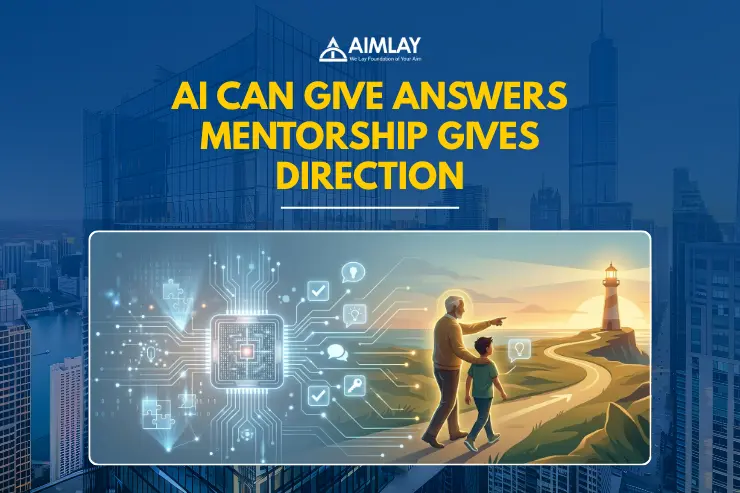
Type a question into an AI tool and you get an answer in seconds. Usually, a good one. Sometimes an excellent one. What you do not get is someone who knows where you are trying to go and can tell you whether the question you asked is even the right one.
That distinction is what separates AI mentorship tools from the real thing. AI is extraordinarily good at retrieval, pattern recognition, and generating options. It is not good at understanding the specific weight of a decision in the context of a specific career at a specific point in time. That requires a person.
Table of Content
• What AI Does Well for Career Growth
• Why Mentorship Matters in the AI Era
• What Mentors Do That AI Cannot
• Professional Networking: Where Mentorship Still Wins
• Conclusion
• Frequently Asked Questions
What AI Does Well for Career Growth
AI skills development tools have genuinely changed what professionals can learn on their own. Personalised learning paths, instant feedback on technical work, real-time answers to specific questions these were not available at scale five years ago. For AI professionals building technical capabilities, the tools are legitimately good.
AI tools bring data-driven insights, assess skill gaps, and automate tasks like drafting résumés or building personalised learning plans. In AI industry roles where the technical landscape moves fast, that kind of rapid feedback loop matters.
The limitation appears when the question stops being “how do I do this?” and becomes “should I do this, and why?” That is where the tool runs out of context — because it has no idea where you actually want to end up.
Why Mentorship Matters in the AI Era
Why mentorship is important in the AI era is best understood by looking at what professionals actually struggle with during career transitions. It is rarely a lack of information. Information is abundant. The struggle is with interpretation — knowing which information applies to their situation, which signals to trust, and which options are genuinely worth pursuing.
The capabilities employees value most empathy, communication, human-centred decision-making are those AI cannot replicate and that mentoring builds best. And according to the same research, strategic and critical thinking, digital fluency, and leadership skills remain the most critical capabilities for 2026, yet only a small proportion of HR leaders feel extremely confident in their strategy for building them.
Career mentorship addresses this gap. A mentor who has navigated similar transitions, made similar decisions, and observed similar patterns across multiple careers brings something no dataset can replicate informed judgement about what actually matters.
What Mentors Do That AI Cannot
The majority of mentoring benefits can be seen during the moments of serious career ambiguity — not just when someone wants to understand how to use a specific tool; but instead when someone is trying to determine if they should take on a new opportunity, redirect the course of their current path, or stand firm as they encounter some level of difficulty in their professional environment.
A mentor provides feedback and/or advice and/or real-world experience which ultimately contributes to the growth of a mentee’s professional abilities, helps them establish meaningful objectives, assists with developing the skills needed for a leader, and ultimately allows a mentee to make informed decisions regarding the direction of their career.
None of those outputs were an “information problem” all three were a “judgement issue,” and judgement can only occur as it develops through the relationships (or experiences) of people – not via search engines.
| What AI Handles Well | What Mentorship Handles Better |
|---|---|
| Technical Skill Gaps and Learning Paths | Career Direction and Goal Alignment |
| Specific How-To Questions | Whether the Question Itself Is the Right One |
| Drafting, Editing, and Option Generation | Judgment Calls and Risk Assessment |
| Pattern Recognition Across Data | Reading Your Specific Professional Context |
| Speed and Availability | Sustained Accountability and Relationship |
The most effective approach pairs AI tools with personalized mentorship using AI to handle quick technical questions and save the mentor’s expertise for big-picture strategy and career advice.
For AI professionals specifically, this matters because the field moves fast enough that technical currency is table stakes. What separates good careers from exceptional ones is usually not technical skill alone but the ability to position that skill intelligently, communicate it to the right people, and make good decisions at critical junctures. That is mentorship territory.
Professional Networking: Where Mentorship Still Wins
Professional networking is one of the mentorship benefits that gets undervalued relative to the guidance function. A mentor does not just advise — they introduce, refer, and vouch. Those actions have compounding effects that no AI career growth tool can replicate because they depend on trust that exists in human relationships, not databases.
In dispersed, digital-first work environments, opportunities for spontaneous moments of learning, as well as building relationships with others are decreasing. Mentoring actively recreates these connections across different departments, time zones, and generations. For workers in the AI industry who move laterally to different areas or have colleagues based remotely; having access to a mentor’s professional network may be what will make the difference between an employee’s career advancing at a slow pace and accelerating.
Professional networking through mentorship also tends to be more targeted than broad networking. An introduction from someone who knows both parties well lands differently than a cold LinkedIn connection. The quality of the relationship transfers to the quality of the referral.
For professionals pursuing advanced academic qualifications alongside active careers whether a postgraduate degree or a doctoral program structured mentorship is what bridges the gap between having a qualification and knowing how to deploy it. Aimlay works with working professionals at exactly this intersection, pairing academic guidance with an understanding of where the qualification fits in a real professional trajectory.
Conclusion
Career growth through mentorship and AI career growth are not in competition. The question is sequencing. Use AI for what it is fast at — skill development, information retrieval, option generation. Bring a mentor in for the decisions that actually define the shape of a career.
Mentorship gives direction in a way that answers alone cannot. An answer tells you what. A mentor helps you decide whether — and that is almost always the harder question.
Why mentorship matters in AI careers is not a nostalgic argument for human connection over efficiency. It is a practical one. The professionals who grow fastest are the ones who use both well.
Frequently Asked Questions
Why does mentorship still matter when AI tools can answer most career questions?
Mentorship remains valuable because most important career decisions are not simply information problems—they are judgment decisions. AI can provide options and information, but mentors offer context, experience, and personalized guidance to help professionals make the best choices for their specific situations.
What are the specific benefits of mentorship that AI tools cannot provide?
Mentorship offers benefits that AI cannot replicate, including long-term accountability, trusted professional relationships, referrals, access to valuable networks, personalized feedback, and guidance based on a deep understanding of an individual’s goals, strengths, and challenges.
How is mentorship different from using AI for career development?
AI is highly effective at identifying general patterns, answering questions, and providing learning resources. Mentorship focuses on the specific context of an individual’s career, industry, goals, and circumstances. This personalized perspective makes mentorship particularly valuable for high-stakes career decisions.
Is mentorship useful for AI professionals specifically?
Yes. AI professionals work in a rapidly evolving industry where technologies and skills change quickly. Mentors help professionals navigate career paths, develop long-term strategies, build industry relationships, and position themselves for opportunities beyond technical skill development.
How does professional networking through mentorship differ from AI-matched networking?
Mentorship-based networking is built on trust and personal relationships. When a mentor recommends or introduces someone, their credibility supports that connection. AI-matched networking can identify potential contacts, but it cannot replace the value of trusted human recommendations and relationship-building.
How does mentorship support career growth in the AI industry specifically?
Mentorship helps AI professionals identify which skills, technologies, and career paths are most valuable for long-term success. Rather than focusing only on the latest tools, mentors provide strategic guidance on where to invest time and effort to remain competitive as the industry evolves.
Want to pursue education while maintaining a full-time career? Look no further than www.aimlay.com to find mentors that know and understand the educational side of pursuing education, as well as the professional side.
