



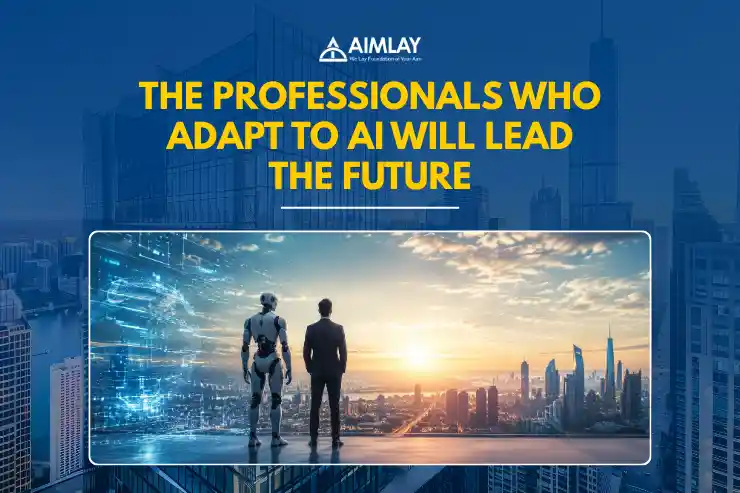
It is a very important time in the history of the profession that we’re experiencing. Artificial Intelligence isn’t a future reality anymore; it’s the present reality of how we work, think, and grow. Those who are first to embrace the use of AI in their professions aren’t merely keeping up with the changes in their workplaces; they are driving them. From healthcare to education, law to business, grasping the impact of AI career growth is the initial step in preparing for a future-ready career that endures.
Table of Content
• How Is AI Changing Professional Careers?
• Will AI Replace Professionals?
• What Skills Are Needed to Work With AI?
• How Does AI Improve Workplace Productivity?
• How Can Professionals Adapt to AI?
• How Can Professionals Stay Relevant in the AI Era?
• What Does the Future of Professional Careers Look Like?
• Frequently Asked Questions
Why Is Artificial Intelligence Important for Career Growth?
Artificial Intelligence is used by companies in the sector and the healthcare industry. They use Artificial Intelligence tools to do tasks that they have to do again. Artificial Intelligence helps them understand the data they have and make decisions. In the workplace, people who know about Artificial Intelligence and use it will be off, then people who do not know about Artificial Intelligence.
AI career growth is more than just picking up the tool; it’s about redefining your career identity. Those who invest in AI skills for success today are becoming invaluable assets, not simply task executors, but assets who can multiply their skills and their worth with technology.
How Is AI Changing Professional Careers?
To gain an understanding of how future of professional careers helps to put the need and opportunity for adapting into perspective. The transformation is taking place in four main aspects:
1. Replace Tasks: Artificial Intelligence can do tasks that are repetitive and follow rules, such as entering data making schedules and making basic reports and so on.
2. Personalization at Scale: Artificial Intelligence makes it possible to give people personalized experiences in areas, including education, marketing and healthcare. There is a need for professionals who can create and manage these kinds of systems.
3. Cross-disciplinary work: Artificial Intelligence is changing the way things are done. Professionals who are ready for the future need to be able to work with technology and ethics and business strategy and human behavior at the same time. They need to be able to do all these things to be successful.
Will AI Replace Professionals?
| Aspect | Professionals Without AI | Professionals With AI |
|---|---|---|
| Task Speed | Manual, time-intensive | Automated, fast execution |
| Data Analysis | Limited and delayed | Real-time and comprehensive |
| Decision Making | Experience-based only | Data-enhanced + experience |
| Career Relevance | Declining in AI-heavy sectors | Growing and in high demand |
| Productivity Output | Standard output | Multiplied output with AI tools |
| Learning Curve | Static professional knowledge | Continuous, adaptive upskilling |
| Job Security | Vulnerable to displacement | More resilient and future-proof |
The people who are driving in the AI era are not the ones that are most technically proficient; they are just the most adaptable. They are also seasoned experts in their field with an understanding of AI tools, enabling them to achieve results that would not be possible without their expertise or AI.
What Skills Are Needed to Work With AI?
The human and technical abilities required for future careers include AI skills. AI can be helpful to people who are not data scientists or software engineers. This is a practical guide for professionals of various fields on how to apply AI skills:
Technical AI Skills:
• Prompt engineering and working with large language models (LLMs)
• To gain an understanding of machine learning fundamentals
• Data literacy is the ability to read, interpret, and challenge insights created by AI.
• Knowledge of AI platforms (ChatGPT, Copilot, Gemini, Mid Journey, etc.).
• Automation tools (Zapier, Make, Power Automate)
Human-Centric Skills (That AI Cannot Replace):
• Critical thinking and ethical reasoning
• Emotional intelligence and empathy
• Creative problem-solving
• Communication and storytelling
• Leadership and organizational change management
The ideal mix, the sweet spot, for artificial intelligence jobs, is technicians who are technically educated, and, at the same time, highly humanistic in their approach.
How Does AI Improve Workplace Productivity?
Productivity is where the advantages of AI are most evident in the workplace. AI has a range of measurable impacts on boosting workplace productivity:
• Saves Time: According to professionals, using AI tools can save between 2 to 10 hours weekly on mundane tasks such as compiling emails, summarizing reports, and creating presentations.
• Minimizes Errors: In industries such as the legal and medical writing, and financial services, AI-driven quality assurance detects errors which might otherwise it go unnoticed by humans in stressful or fatigued environments.
• Supports Accelerated Learning: AI learning platforms personalize the pace and style of learning, enabling professionals to upskill more quickly and effectively, as opposed to classroom learning.
• Enhances Collaboration: AI meeting tools, project management assistants, and smart communication platforms ensure teams are more aligned and efficient, all the way from across the globe to across time zones.
How Can Professionals Adapt to AI?
Maybe the most actionable question of our time is what modifications can be expected in the workplace because of AI. Adaptation is not about a single occasion, but a process of changing ways of thinking. A development framework for practitioners at every phase:
Step 1: Analyze current position tasks
Determine repetitive, rule-based tasks in the current position. First, it is the tasks that AI will help with! Knowing this will help you be prepared for change that can otherwise come as a shock.
Step 2: Build AI Literacy
It is not a requirement in computer science. Take free or low-cost courses to help you get started, such as on Coursera, LinkedIn Learning, or Google’s AI Essentials. Know how to operate tools applicable to the industry.
Step 3: Experiment Actively
Try out AI tools in low-stakes environments. Create reports with ChatGPT, analyze spreadsheets with Copilot, or make presentations with Canva AI. Adoption is fasted when it is done hands on learning.
Step 4: Stay Ethically Informed
As a professional working with AI, understanding all the bias, data privacies, and responsibility for AI use is a career skill which is not just an ethical obligation.
Step 5: Invest in Your Uniquely Human Skills
Double down on what is made by humans: your relationships, your judgment, your creativity, your leadership, and many more. These are your competitive advantages in an AI-assisted world.
Step 6: Build a Learning Community
Connect with others who are on the journey of using AI. Peer learning, conferences, webinars and industry forums will help you grow by a factor of ten times.
How Can Professionals Stay Relevant in the AI Era?
In the era of AI, it is essential to change professional identity. These are the attributes that all professionals in the future will have:
They aren’t afraid, they are curious: Rather than being afraid of AI, they are curious. They seek to understand how AI can assist them in doing their best not to do their work.
They are Lifelong Learners: Professional skills are becoming increasingly transitory. Relevancy experts never stop learning. Relevancy experts never stop learning; it’s not a checkbox.
They are focused on Outcomes, not Tasks: The talent of AI era workers is defined by results, not hours worked or tasks completed.
What Does the Future of Professional Careers Look Like?
The future of professional careers is collaborative with that of human intelligence and artificial intelligence.
• Rather than tackling problems that AI can solve, the ability to define problems that AI can solve.
• The skills necessary to make critical assessments of AI-generated content
• Ethics to make sure the use of AI is responsible.
Each technological revolution in history has been accompanied by a corresponding payoff for those who embraced it early and stressing for those who took too long. As with most things in history, every major technological advance has been accompanied by an increase in the value conferred on the early adopters and an increase in the relative value of the latecomers. AI is no different.
The key players in the new era of AI will not be the ones with the greatest amount of data or the most sophisticated algorithms. It will be up to them to have the wisdom to use both wisely.
Frequently Asked Questions
Will professionals be replaced by AI in the future?
But AI is not a different thing from professionals; it replaces those who are not ready to use it. People who develop and use AI and combine it with skills will be in high demand and can’t be replaced.
What can professionals do to adapt to AI quickly?
Start by learning about AI taking online courses, trying AI tools that work for you and improving human skills like critical thinking and communication that AI can’t do.
How important is AI in career development?
In industries, knowing AI is becoming a basic requirement. Those who are good at using AI tools are more productive have an edge in the job market and are more creative.
How does AI make work easier and faster?
AI saves professionals time every week by doing tasks reduces mistakes and helps make better decisions with data, leading to better results.
How can professionals stay important in the AI era?
Professionals stay important by learning to get good with AI in their field, focusing on results rather than tasks and improving human skills that AI can’t do.
