



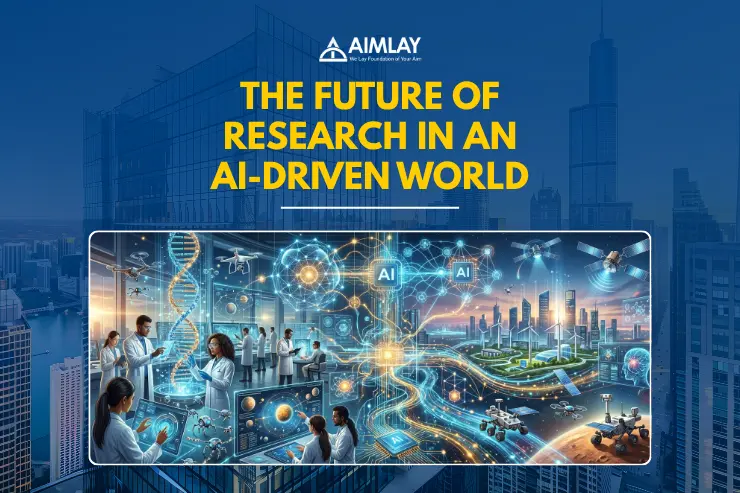
Something shifted in research around 2026, and it has not stopped shifting since. The change is not just that AI tools are faster or cheaper. It is that the actual architecture of research in an AI-driven world how hypotheses form, how literature gets reviewed, how data gets interpreted is being reorganized from the inside out.
The future of research is not a clean upgrade from the old version. It is a different kind of work, with different pressure points. And the researchers who understand that distinction are already working differently from those who do not.
How AI Is Transforming Academic Research
AI is changing how we carry out research primarily by way of its impact on the first step in the research process.” In an early 2026 interview with Microsoft Research’s Peter Lee, he stated this paradigm shift in terms of “research”: “AI is no longer simply creating summaries of research papers and/or producing reports AI is actually participating in the discovery process; developing hypotheses; utilizing equipment (tools) which will enable scientists to conduct their own experimentation; and collaborating with other researchers (both human and artificial intelligence).”
This is a significant shift away from considering Artificial Intelligence as merely upgrading the functionality of a search engine. AI is currently impacting the generation of hypotheses a component of research that historically has been thought to be irreplaceably human.
For active researchers, this means that the amount of time researchers have to explore through literature prior to embarking upon actual research is compressing. For example, tools are being developed that index over 130 million academic papers. These tools allow researchers to quickly find relevant studies; pull-out structured findings related to each study; create maps of citation networks between studies within a matter of hours. The weeks that were previously lost at the beginning of the research project due to excessive amounts of exploratory literature work are decreasing. The key issue is what researchers will choose to use the recovered time for.
AI-Powered Innovation in Research: What’s Actually Changing
AI-powered innovation in research is concentrating in three areas.
The first is speed. Fields like climate modelling, materials science, and molecular dynamics — areas where simulation is expensive and iteration cycles are long — are seeing results that would previously have taken years arrive in months. AI agents can run parallel experiment streams, flag anomalies, and suggest next steps without waiting for a human to review each output.
The second is cross-disciplinary connection. AI-assisted research tools are finding patterns across literatures that no single researcher would think to combine. A genomics finding relevant to materials science. An econometric method applicable to epidemiology. The cross-pollination is accelerating, and the researchers positioned to act on it are those working in areas adjacent to multiple fields.
The third is access. Researchers at institutions with limited library budgets or small teams now have access to tools that previously required large research infrastructure. The playing field is not level, but it is less uneven than it was.
Research Methodologies in the Age of AI
A variety of longstanding research methodologies face a need for reform. Many traditional approaches were developed as a response to limitations that are being eliminated by AI, such as the amount of data available to be analyzed, the time required to analyze the large amounts of data; and access to published studies. Once those restrictions are removed (to varying degrees), some of the methodological decisions made in order to address them will no longer be needed but instead be discretionary.
For example, systematic review protocols were developed partially because there was an overwhelming number of studies that human reviewers could never have processed uniformly without them. While AI-assisted research tools can assist with both screening and extracting information from the literature, this does not mean that systematic reviews will disappear. Instead it means the work done by humans within these types of reviews will shift towards interpreting and judging versus doing manual tasks.
Conversely, mixed-methods research is gaining renewed interest due to the inverse. There is quantitative data that AI has greatly improved at handling, however there is also qualitative data that AI continues to poorly handle. As a result, the combinations of what machines can now do quickly and efficiently and what machines continue to be unable to do well, is causing a transformation of how many different methodological approaches lead to credible and contextualized results.
Academic Research Trends Worth Watching
Academic research trends in 2026 reflect the uneven distribution of AI adoption across institutions and disciplines.
| Trend | What It Means in Practice |
|---|---|
| Agentic AI in Experiments | AI agents running and adjusting experiments in real time |
| Cross-Disciplinary Discovery | AI surfacing connections across traditionally separate fields |
| Policy Pressure on AI Use | Journals and institutions developing AI disclosure requirements |
| Shorter Literature Review Cycles | Discovery tools compressing early research phases |
| Increased Focus on Interpretation | Human effort shifting from retrieval to analysis |
n the future as we move into an age of AI; it is becoming clearer that researchers in the field will have to explicitly state which areas of their research involved the use of AI, and how those results were verified. Journals are beginning to set standards for this level of transparency with respect to AI. If researchers can anticipate these changing norms and become transparent before they become required by journals or regulatory agencies; they may avoid the possibility of retroactively scrutinizing the work done using AI.
For working professionals in doctoral programs, the methodological shift matters practically. Navigating AI in research within an academic institution — understanding what tools are acceptable, how to document AI-assisted work, and how to maintain research integrity — is part of what structured guidance addresses. Aimlay supports doctoral candidates through exactly this phase, helping researchers use available tools without compromising the integrity of their contribution.
What Stays Human in AI-Assisted Research
The impact of artificial intelligence on research is real, but unevenly distributed across the research process. The parts AI handles well — retrieval, pattern detection, initial drafting, data processing — are the parts that previously consumed time without requiring the highest levels of researcher judgement. Those time savings are genuine.
The parts AI handles poorly are the ones that define what a research contribution actually is. Forming a question that is worth asking. Deciding which findings matter and why. Situating results inside the broader debate of a field. Defending a position to people qualified to challenge it. Technology in research improves the surrounding infrastructure. The intellectual core stays with the researcher.
Future academic research will require people who can move fluently between what AI does and what they do — not because the boundary is fixed, but because understanding where it currently sits is what allows researchers to use both well.
Conclusion
The future of the pursuit of knowledge in an age of Artificial Intelligence is not one of the elimination of researchers. Rather, it is a future of redistributing time, energy, and the critical thought that makes the best research.
Innovation in research is increasing at rates faster than ever before in the areas where AI has developed. While there is certainly less barrier to accessing literature or computational power, what is now slowing down the rate of new discoveries is the quality of questions that researchers can ask, and how well they interpret their results. This limitation on advancing new discoveries remains to be based upon humans. Therefore, researchers who perceive both the potential for artificial intelligence to enhance the process of discovery and view the relationship between researcher and technology as collaborative rather than competitive will be those doing the most compelling research over the coming years.
Frequently Asked Questions
What is the future of academic research in an AI-driven world?
The future of academic research involves using AI to handle routine and computational tasks such as data retrieval, pattern recognition, literature discovery, and information organization. This allows researchers to focus more on hypothesis development, interpretation, critical analysis, and generating original contributions to knowledge.
How is AI transforming research methodologies?
AI is reshaping research methodologies by automating tasks that previously required significant manual effort, such as systematic reviews, large-scale data coding, and information processing. As a result, researchers can dedicate more time to designing studies, interpreting findings, and providing contextual understanding.
What are the most significant academic research trends in 2026?
Key research trends include agentic AI participating in experiments, faster literature review processes, AI-driven cross-disciplinary discoveries, greater use of intelligent research assistants, and increasing institutional requirements for transparency regarding AI use in research projects.
What is the impact of artificial intelligence on research integrity?
The impact depends largely on how responsibly AI is used. Research integrity is maintained when researchers disclose AI usage, verify outputs, and remain accountable for all findings and conclusions. Concerns such as fabricated citations, undisclosed AI assistance, and inaccurate outputs have led journals and institutions to establish new disclosure and transparency guidelines.
How does AI-powered innovation change what researchers need to know?
Researchers must understand which AI tools are appropriate for specific research tasks, how to validate AI-generated outputs, and how to document AI usage according to institutional and publication standards. While workflows are changing, domain expertise and critical thinking remain essential.
Is AI-assisted research suitable for doctoral and postgraduate work?
Yes. AI-assisted research can support doctoral and postgraduate students by improving efficiency during literature reviews, data analysis, writing, and project organization. However, researchers must verify all information, maintain academic integrity, properly disclose AI usage, and ensure that the intellectual contribution remains their own.
Navigating AI tools in a doctoral or postgraduate research program? Visit aimlay.com to connect with academic mentors who help working professionals manage research integrity and methodology throughout the process.
