



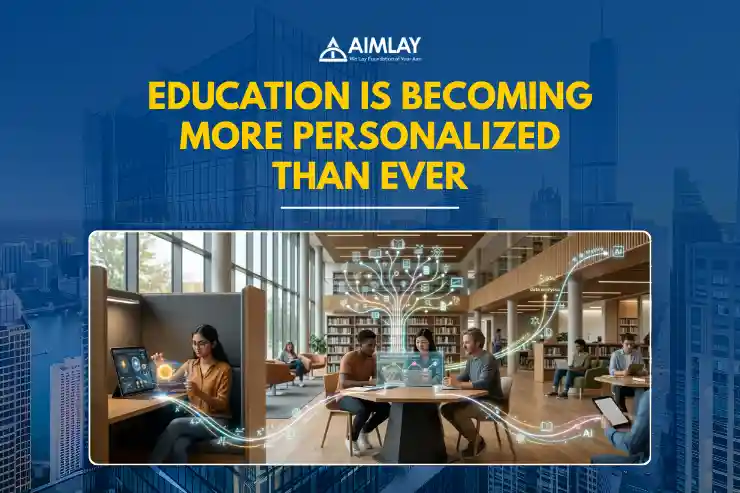
The classroom that we once knew quickly changed. New technologies, artificial intelligence, and a focus on learner-centred education are challenging institutions around the world to rethink knowledge delivery, assessment and experience. Whether it’s through undergraduate degrees or PhD courses, or the best business schools, personalized education is no longer the stuff of dream; it’s reality today and defining education at all levels.
Table of Content
• How Is AI Enabling Learner-Centric Teaching Strategies at Scale?
• How Is Personalized Learning Reshaping Doctoral Education and PhD Programs?
• What Are the Benefits of Personalized Education in Business Schools?
• How Does Personalized Education Compare Across Different Program Types?
• What Role Does Educational Leadership Play in Driving Personalized Learning?
• How Is the Future of Business Education Being Redefined by Personalization?
• What Is Competency-Based Selection and How Does It Advance Personalization?
• What Challenges Must Institutions Overcome to Truly Personalize Education?
• Frequently Asked Questions
What Is Personalized Education and Why Is It Changing Higher Education?
Personalized learning (education) means making learning experience content, pacing, assessment and learning paths unique to each learner based on their needs, strengths, and aspirations. In the context of higher education, it implies shifting from a lecture-based model of instruction to a more responsive system that adapts in real time.
The platforms with AI capabilities are now able to analyze a learner’s learning patterns, identify gaps in knowledge, and even present personalized content before a learner realizes they are not learning. Those institutions that have adopted a student-centered learning approach in higher education are reporting higher engagement, increased retention rates, and much improved academic outcomes.
The underlying concept is simple: students don’t learn the same, at the same speed, towards the same end point. Personalization respects reality.
How Is AI Enabling Learner-Centric Teaching Strategies at Scale?
Artificial intelligence is the engine powering the most effective learner-centric teaching strategies today. Machine learning algorithms can:
• Monitor micro-behaviors are concept Time, Error Patterns, Quiz Performance to create comprehensive learner profiles.
• Tailor content delivery to show the video explanation, text-based explanation, or interactive simulation, depending on the person’s preference.
• Forecast students who are at risk of dropping out as early as weeks in advance, allowing intervention by faculty.
• Use and implement feedback loops to provide students with immediate, detailed feedback, rather than waiting weeks for them to receive their graded papers.
Some learning platforms (like Coursera, Minerva, Carnegie Learning) have already proven that learning-centric education at scale is attainable and viable, given the proper technology infrastructure.
How Is Personalized Learning Reshaping Doctoral Education and PhD Programs?
In the past, doctoral education has been one of the most individual modes of education, which is focused on advisor-student relationships. However, even PhD programs have evolved, with structured personalization now being at a systemic level.
Modern doctoral programs are now incorporating:
• Career Plans and Individual Development Plans (IDPs) are personalized maps of student research interests and career aspirations and identify skill gaps.
• Courses and examinations that enable students to work at varying speeds and rates to achieve the same competence.
• Tools for literature mapping with AI that support doctoral candidates in the identification of gaps in the research, in the context of their own research interests.
• Cross-disciplinary flexibility students in personalized learning in doctoral programs can take courses from a variety of departments according to the dissertation requirements.
• Examples of this are being developed by institutions such as MIT, Stanford, and other research universities in Europe, which are starting to break down the linear tradition of doctoral study and making it a more flexible and student-driven experience.
What Are the Benefits of Personalized Education in Business Schools?
The personalization revolution is one of the most dramatic in management education and business school strategy in the whole of academia. Rigid MBA programs are increasingly out of date in today’s world, as competition among business schools and the requirements of employers are growing and changing.
The benefits of personalized education in business schools include:
1. Curriculum Flexibility: Students have the option to select elective tracks, concentration areas, and even to co-design independent study modules to fit their industry of interest, be it venture capital, sustainability or health care management.
2. Competency-Based Progression: Students that can prove that they can do a particular concept proceed at a quicker pace through competency-based selection. For those who might need to be reinforced, it will be done without the label of “falling behind.”
3. Career-Aligned Learning Paths: AI tools which now match students with case studies, simulations, and capstone projects that mirror their target career trajectories, which are making the MBA experience directly applicable, not theoretically abstract.
4. Real-Time Industry Integration: Business schools who are embedded with the live market data, current business challenges, and executive mentors into their personalized learning dashboards, and bridging the gap between education and industry faster than ever.
How Does Personalized Education Compare Across Different Program Types?
| Feature | Traditional Model | Personalized Education Model |
|---|---|---|
| Curriculum Structure | Fixed, standardized for all | Adaptive, student-directed |
| Learning Pace | Uniform semester timeline | Self-paced or competency-based |
| Assessment Style | Standardized exams | Portfolio, performance, project-based |
| Faculty Role | Lecturer/instructor | Mentor, coach, facilitator |
| Technology Use | Supplementary (LMS) | Core (AI, adaptive platforms) |
| Feedback Speed | Delayed (weeks) | Immediate (real-time AI feedback) |
| Doctoral/PhD Application | Advisor-driven only | IDP + AI-assisted research mapping |
| Business School Application | Fixed MBA tracks | Career-aligned modular pathways |
| Student Engagement | Passive absorption | Active co-creation of learning |
| Outcome Measurement | GPA-centric | Competency and skills-centric |
What Role Does Educational Leadership Play in Driving Personalized Learning?
Visionary educational leadership is the key to the success of any technology or curriculum design. Institutional culture is shaped by the deans, provosts, department heads, and program directors: and institutional culture determines the success of personalization or its failure.
What the new world of personalized learning requires from leaders of learning:
• Promotes a growth mindset in faculty that inspires teachers to embrace adaptive teaching as a journey of growth and not fear.
• Dedicates resources to training teachers on the use of AI generated learner data and on how to make effective pedagogical changes based on this data.
• Overcomes departmental barriers establishing interdisciplinary committees which can develop and lead to flexible and competency-based curricula.
• Focuses on equity in personalization, using adaptive tools to meet the needs of first-generation students, students with disabilities, and non-traditional students equally well as traditional students.
Schools that are doing “education by design” not as an experimental program that personalization is a strategy being used are outperforming their peers on student satisfaction, graduate employment, and research.
How Is the Future of Business Education Being Redefined by Personalization?
Personalization is a part of future business education. As disruption is a constant, global business schools including INSEAD and Wharton, but also some new schools in Asia and Africa are reconsidering the meaning of an MBA.
Key trends defining this future include:
• Stackable Credentials: Students who want to commit to a two-year program of study can take multiple modular certificates that can be stacked into a degree, at their own pace, depending on their career phase.
• AI-Powered Career Matching: Business schools are using AI advisors to look at a student’s background, goals, and market trends to make recommendations for a mix of courses, internships, and projects that are most likely to lead to a desired result.
• Global Cohort Personalization: There can be different variations of the theme (such as sustainable supply chains) for students in the same cohort for example, a geographical lens, a case study, an expert network can differ widely based on the geographic location of the students and their career focus.
• Executive Education Integration: The distinction between degree programs and executive education is becoming less clear. The future of Business Education will be enhanced by the ability to enter, pause and resume learning journeys without losing momentum, as enabled by personalization.
What Is Competency-Based Selection and How Does It Advance Personalization?
Competency Based Selection is a philosophy and methodology that assesses student performance (and sometimes admission) based on competencies rather than seat time only or grades only.
In a personalized education framework, competency-based selection means:
Students advance when they prove mastery, not when the calendar says so.
Admission to graduate and doctoral programs is based on project portfolios, projects, and demonstrated abilities, not just on standardized test scores.
Faculty can differentiate instruction more accurately, having a clearly documented chart of where each student is and where they are missing.
This is especially important for management education the more that employers seek management graduates with the ability to demonstrate competencies – leadership, analysis, cross-cultural communication – rather than a transcript littered with A’s, the more potent this is.
What Challenges Must Institutions Overcome to Truly Personalize Education?
While there are opportunities for personalized education, there are also challenges:
1. Data Privacy Concerns: The richness of learner data which enables personalization also brings with it important questions of who owns this data, how it is stored, and how it can be used and/or monetized.
2. Faculty Resistance: Many jaded school teachers who have been well trained in traditional pedagogy are disoriented by adaptive, learner-led models. Even the best systems can be undermined by resistance, if there is no institutional support or retraining.
3. Infrastructure Inequality: Not every institution (particularly in the Global South) can afford or build the technological infrastructure or financial resources to be able to implement a sophisticated adaptive learning platform that is equitable.
4. Scalability vs. Depth: There is a continuum of “depth” in personalization going to a truly deep level to change a student’s intellectual trajectory which can only come in part from humans. The crux of the problem in student centred learning in higher education is how to scale it without losing depth.
Frequently Asked Questions
What is personalized education?
Personalized education provides instruction that allows for customizing subject matter, pace, and assessments according to the individual needs, goals, and learning styles of each student, rather than following a single standardized curriculum for everyone.
What are the principal advantages of personalized training in business schools?
Business schools benefit from personalized learning through flexible learning pathways, competency-based progression, career-focused education, stronger industry alignment, and improved student outcomes that better match workforce demands.
What are the impacts of educational leadership on personalized learning?
Personalized learning moves from isolated initiatives to institution-wide transformation when strong educational leadership supports the necessary culture, investment, policies, and strategic direction required for successful implementation.
What will business education look like in the future in terms of personalization?
The future of business education is expected to include stackable credentials, AI-driven career guidance, modular MBA program structures, and flexible learning experiences that adapt to students’ career stages and professional goals.
Is an individualized approach to education only for elite universities?
No. While well-resourced institutions have often led the adoption of personalized learning models, open-source adaptive technologies, digital learning platforms, and government-supported edtech initiatives are making personalized education increasingly accessible across institutions and income levels.
