



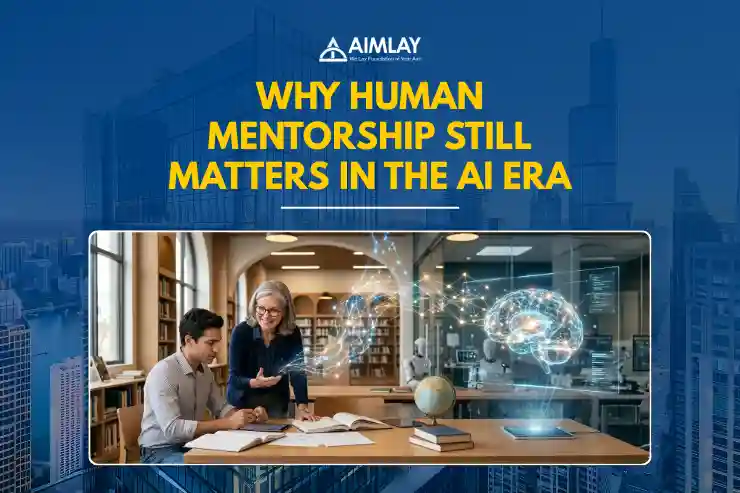
There is a version of the AI-in-education story that goes like this: algorithms know what you need, adaptive tools deliver it, and the human teacher or mentor becomes optional infrastructure. It is a clean story. It is also wrong.
Human mentorship in the AI era is not declining in relevance. If anything, the proliferation of AI-assisted learning tools has made what human mentors do best more visible by contrast because AI is very good at some things and genuinely cannot do others.
Table of Content
• What Only Human Mentors Actually Do
• Emotional Intelligence: The Unbridgeable Gap
• How Human Mentorship Complements AI
• The Role of Mentorship in Modern Education
• Conclusion
• Frequently Asked Questions
What AI Does Well in Education
AI-based learning systems can deliver both retrieval and practice components of learning with greater efficiency and effectiveness than humans at large scales. Real-time adaptive algorithms continuously assess a learner’s performance and adjust the difficulty of their work accordingly. Learners receive instant automated responses as opposed to delayed ones from human instructors.
Additionally, tracking each individual learner’s progress throughout the duration of the course/program becomes significantly easier (and less likely to be lost) than under traditional instructional methods. The World Economic Forum has made similar points regarding how AI eliminates many routine administrative tasks which frees those who were previously engaged in these activities to spend more time engaging in mentoring. This perspective is relevant; AI will only serve its purpose when used to create opportunities for humans to provide direction/guidance versus attempting to supplant them.
What Only Human Mentors Actually Do
The importance of human mentorship becomes most visible at the moments when AI reaches its limit. A student who is technically progressing but quietly disengaging. A doctoral candidate who has the data but cannot form an argument from it. A working professional who knows what they need to do but cannot get themselves to do it. These are not information problems. No AI and human mentorship comparison resolves cleanly in AI’s favour here.
According to research cited in HR and talent development contexts, the capabilities professionals value most — empathy, communication, human-centred decision-making — are exactly the ones AI cannot replicate and that mentoring builds best. The same research notes these as the most critical capabilities for 2026, yet the readiness gap in developing them remains significant.
Human skills vs artificial intelligence is not a competition. It is a division of labour. AI is faster at retrieval. Humans are better at context. AI optimises for stated goals. Mentors challenge whether the stated goal is the right one.
Emotional Intelligence: The Unbridgeable Gap
Emotional intelligence in education is the clearest example of what separates a mentor from a tool. A mentor who has been through a similar process — the same uncertainty, the same kind of setback, the same institutional friction — can offer something that no amount of training data produces: recognition.
Being recognized as a person who has actually experienced that which you are experiencing (and have also overcome) can impact your experience of difficulty. Recognizing another individual does not make the difficulty less difficult in terms of how much work or time is involved; however, it impacts your way of relating to it. This is an important factor. Mentorship relationships in research concerning academic retention, have been identified as one of the most significant factors in determining if students will continue through their academic program.
At this point in the educational process, human guidance is not about sharing information. The role of the guide/mentor is to be there during those aspects of learning that are naturally un-pleasant, and to have sufficient experience so they can support the learner to stay engaged in their own difficulties, instead of avoiding them.
How Human Mentorship Complements AI
The primary focus of human mentoring during an individual’s educational development is not to provide students with new information. Rather, human mentors are there for the difficult moments of the educational process. These are the moments when an individual learns something he or she did not want to learn. While human mentors have experience, which allows them to assist an individual to stay engaged in the process (i.e., be present with the discomfort) as opposed to avoiding the discomfort, human mentoring cannot replace technology in the way technology replaces human teachers. This is due to the fact that technology can assess an individual’s knowledge on every subject by providing immediate feedback based upon each student’s performance.
For professionals pursuing doctoral or postgraduate qualifications alongside full careers, this distinction is not abstract. The research phase of a doctoral program, in particular, is where structured AI tools reach their limit. The work is not about retrieving information. It is about forming and defending an original contribution to a field. That process requires someone who understands both the academic requirements and the candidate’s specific professional context which is exactly the kind of support Aimlay provides to working professionals navigating research-stage doctoral programs.
The Role of Mentorship in Modern Education
The role of mentorship in modern education has not diminished with the arrival of AI. It has become more specific. Mentors are no longer the primary delivery mechanism for content that role has largely moved to digital platforms. What mentors do now is work with the parts of learning that require a person.
That includes helping students form questions that are actually worth asking. Providing feedback that addresses the reasoning behind an answer, not just the answer. Modelling how to handle not knowing something. These are not activities that can be automated.
Mentorship in the age of AI works best when both elements are used for what they are actually good at. The combination produces something neither can alone.
Conclusion
Why human mentorship still matters in the AI era is not a complicated argument. AI is good at scale, speed, and personalisation within a defined problem space. Human mentors are good at the things that sit outside any defined problem space: judgement, context, recognition, and the sustained attention that makes long-term development possible.
The importance of human guidance in an AI-driven world does not require defending AI’s limitations. It requires being honest about what education is actually trying to do — and recognising that the most important outcomes cannot be automated.
Frequently Asked Questions
Why does human mentorship still matter when AI can personalise learning?
Human mentorship in the AI era matters because personalised content delivery is not the same as development. AI adapts what is presented. Human mentors address why someone is struggling, whether their goal is the right one, and how to sustain effort when motivation disappears. These are not information problems.
What can human mentors do that AI cannot?
Human skills versus artificial intelligence differ most in areas such as judgement, empathy, and contextual understanding. Mentors draw upon personal experience, challenge assumptions, provide perspective, and offer meaningful encouragement that supports long-term growth and persistence.
How does emotional intelligence factor into education and mentorship?
The emotional aspect of mentoring is central to effective learning. Mentors can recognize discouragement, understand resistance to feedback, and help students remain engaged through challenges. Research consistently shows that strong mentor-student relationships play a significant role in academic success and degree completion.
How does human mentorship complement AI-assisted learning?
Human mentorship and AI-assisted learning serve different but complementary roles. AI supports content delivery, pacing, and progress tracking, while mentors provide motivation, guidance, adaptability, and the personal support needed to sustain long-term learning goals.
Is mentorship in the age of AI becoming more or less important?
Mentorship is becoming more important as AI handles more content-related tasks. Human mentors continue to play a vital role in challenging assumptions, encouraging critical thinking, supporting personal development, and helping individuals navigate complex learning and career decisions.
What role does human guidance play in postgraduate and doctoral education?
Human guidance is essential in postgraduate and doctoral education, particularly during the research process. Mentors provide academic direction, research supervision, contextual insights, and support for original contributions—areas where human expertise remains irreplaceable despite advances in AI tools.
Working through a doctoral or postgraduate research program? Visit aimlay.com to connect with mentors who support working professionals through the research and writing stages.
