



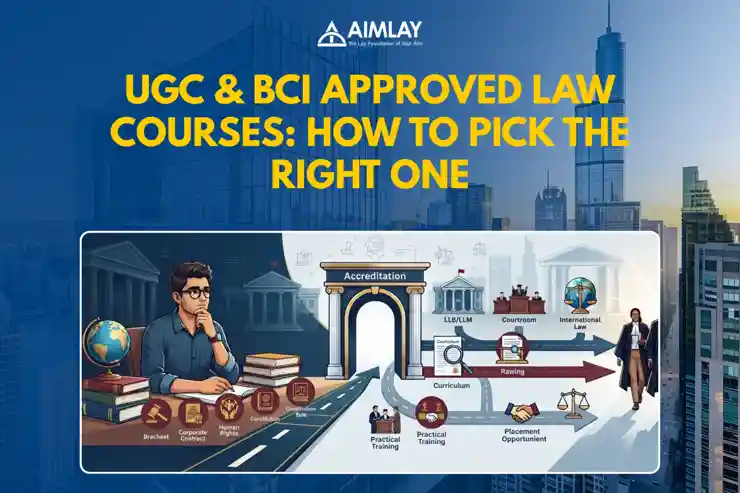
Choosing which law subjects to take is a significant decision and a wrong choice regarding accreditation can result in a lost career. In this blog, you will find out what UGC approved law courses and BCI approved law courses are, how to verify their authenticity and what should be your choice of a law course after class 12th or graduation.
Table of Content
• What Is the Bar Council of India (BCI)?
• What Is the Difference Between UGC Approval and BCI Approval Law Courses?
• Why do Advocates need BCI Certification?
• How to Verify BCI Approved Law Colleges?
• How Can Students Determine if a Law Course Is Approved?
• What are your options after taking a Law Course at the 12th standard?
• Best Law Courses in India: What to Except?
• Final Thoughts
• Frequently Asked Questions
What Is the University Grants Commission (UGC)?
The University Grants Commission (UGC) is the body which determines the universities that are allowed to award a valid degree in India. If a university is not recognized by the UGC, one cannot use degrees from such a university for its career or studies or get jobs in government sectors. Thus, one of the first things that you need to look for any law degree in India is whether the University is UGC approved or not.
What Is the Bar Council of India (BCI)?
The Bar Council of India (BCI) is the regulatory body concerned particularly with the education and the practice of law. The UGC has a broad approach while BCI has a targeted approach to verifying that a particular law course meets standards necessary for graduates to practice advocates. This is the one that really matters – it’s a separate approval.
What Is the Difference Between UGC Approval and BCI Approval Law Courses?
This is one of the most common doubt among all the students have, so here’s the simple version:
• To receive the UGC approval, the university itself is granted permission to award degrees.
• If a law course is approved by the BCI, it fulfills the academic and training requirements of the Bar.
A UGC approval law course and not approved by the BCI. If so, the degree will be valid on paper, but not usable for practicing law. That is why both these approvals must be verified individually and not taken for granted.
Why do Advocates need BCI Certification?
Becoming a practicing lawyer does not depend on BCI approval; it is required. Without it:
• It is not possible to register with any State Bar Council
• It is impossible to appear in all India Bar Examination (AIBE)
• You are not allowed to act as a lawyer for others in court.
• The degree will not be accepted by many law firms and judiciary exams
If the course is not a BCI approved course, it will not enhance your options if you change your mind later, just to avoid the hassle of litigation.
How to Verify BCI Approved Law Colleges?
It’s not difficult to check a college accreditation; it just takes the right sources as opposed to taking the word of a college brochure. Here’s how:
1. Go to the official site of the Bar Council of India and find a list of approved law colleges.
2. Cross-check the university’s guidelines on the UGC website separately.
3. Confirm that the approval applies to the exact course you’re applying for, not just depending on the institution overall.
4. Request a BCI letter of approval or affiliation number from the college directly.
5. Use terms such as “recognized” or “affiliated” with ads only in the official government lists for real approval.
How Can Students Determine if a Law Course Is Approved?
In addition to BCI and UGC websites, students should:
• Visit the university’s official website to look up the course, rather than the admissions website.
• Ensure that graduates of the course have successfully registered with a Bar Council.
• If in doubt, contact the State Bar Council office
• Be wary of dual-approved claims which cannot be independently verified.
It takes just minutes to check, and years of regret to pay for.
What are your options after taking a Law Course at the 12th standard?
There are a few categories of law degree in India. Let’s make a comparison:
| Course | Duration | Eligibility | Good For |
|---|---|---|---|
| 5-Year Integrated LLB (BA LLB, BBA LLB, BCom LLB) | 5 years | After Class 12 | Students who know early they want law |
| 3-Year LLB | 3 years | Graduates (any stream) | Career switchers, late starters |
| LLM | 1–2 years | LLB graduates | Specialization, teaching, judiciary prep |
| Diploma/Certificate courses | 6 months–1 year | Varies | Add-on knowledge, not for Bar enrollment |
What Are the Best Law Courses After 12th?
The most used, BCI approved course methods for students beginning immediately after school are:
• BA LLB: This is the best course for students who are interested in the social/political aspect of the law.
• BBA LLB: For aspiring to pursue corporate law or business law careers.
• BCom LLB: Best for students interested in the combination of finance/accounts and law.
• A specialized programme for students who have an interest in both Science and Law (e.g., Patent Law) – BSc (Science) + LLB (Law).
These are all 5-year integrated courses, and their worth will depend solely on whether the course itself is BCI-approved or not.
Best Law Courses in India: What to Except?
Best” does not necessarily imply that it’s the best of the best colleges. A good Law course should be:
• Valid UGC and BCI approval for the exact program
• Excellent internship experience at law firms, chambers or courts
• The emphasis is on court practice and practical training, rather than lecture
• Faculty that includes practicing advocates,
• To some extent support in preparation for the AIBE (Bar exam) before graduation
How to Choose the Right Law Course in India?
If accreditation is verified, it’s easy to determine:
1. Match the course to your stage: If you have completed 12th, check out integrated LLB courses and after completion of your graduation, check out the 3-year LLB course.
2. Consider specialization: There are different strengths and interests that are needed for corporate law, criminal law, IP law, etc.
3. Look at the format of the internship: The legal profession is a hands-on profession, and internship experience will be as important as classroom education.
4. Review faculty quality: Guest faculty is of great benefit practicing lawyers.
5. Verify the study method: Regular on campus courses are the best for BCI validity.
Final Thoughts
While there are a few options available for legal education in India, only two are important to note, UGC approved course recognition for the degree to be valid and BCI approval to practice law. Prior to considering rankings, fees or claims of placement, check both approvals independently via official sources. After you have made that determination, select an area of law that you are interested in, what stage you are at in your career, and your long-term career objectives.
Frequently Asked Questions
UGC vs BCI Approval of Law Courses: What’s the difference?
The UGC approval course means that the university is authorized to award degrees, and the BCI approval means the law course is approved as per the standard set by BCI for practicing law.
What is the need for BCI approval for prospective advocates?
A graduate without approval from the BCI will not get enrolled with a State Bar Council, appear before the Indian courts or may be able to practice law.
What are students doing if they are unsure whether a law course is approved?
Always go to the official BCI and UGC websites and ensure that it is not just for the University but for the specific course.
Is Online LLB Degree valid in India?
If it’s specifically offered via BCI; BCI has very particular rules about distance legal education, so it’s important to verify prior to enrolling.
Do I need BCI approval to work in legal careers?
Certain legal careers, like corporate legal assistance, contract management, compliance and legal research, may not necessitate Bar enrollment. While advocacy is a profession that can be practiced, it does require a BCI approved degree and Bar Council registration.
May I change my career to a legal profession?
Yes. A 3-year LLB course from any recognized university with a BCI approval is available for all graduates from any stream.
Is there a way to do an LLM if I have an LLB that is not approved by the BCI?
The admission requirements will differ from university to university, but if you are looking to become a lawyer, you will want to have an LLB that is approved by BCI.
What courses are available for 3 years?
A student could be admitted to 3-year LLB after completing his/her bachelor’s degree in any recognized stream.
What will happen if I attend a law course that is not a BCI approved course?
The degree might be valid, but the degree cannot be registered with State Bar Council, nor can you practice as a lawyer in India.
What is the process of finding out whether a college of law is approved by BCI or not?
Check the official Bar Council of India website and see whether the college and type of law program is listed as an approved college or not.
