



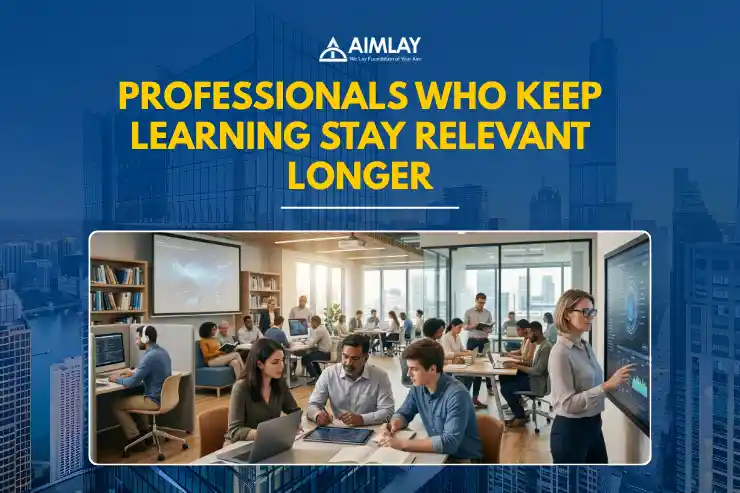
Here is the short version: professional skills now expire twice as fast as they did a decade ago. What once took fifteen years to become outdated now takes around five. 53% of organizations say critical skills in their industry become obsolete within three years or less. That is the entire argument for continuous learning in one statistic. Professionals who keep learning stay relevant longer because the alternative relying on knowledge acquired once and applied indefinitely is no longer mathematically viable in most fields. 91% of L&D professionals now say continuous learning is more critical than ever for career success. The rest of this article shows exactly why and how. But if you only read this paragraph, you have the core of it.
Table of Content
• Why Is Continuous Learning Important?
• How Continuous Learning Helps Career Growth
• Upskilling vs Reskilling: What’s the Difference?
• Examples of Continuous Learning in the Workplace
• How Professionals Can Develop New Skills
• Conclusion
• Frequently Asked Questions
What Is Continuous Learning?
Because the other option is getting more dangerous. Between 2025 and 2030, 39% of core worker skills will change or become obsolete. Also, 63% of all employer’s main obstacles for transforming themselves are due to lack of employee skills. And those who know what I’m talking about are already preparing: 74% state they will learn new skills to continue being employed.
Upskilling is important in the workplace because it is less expensive and faster than the alternative.
89% of companies say it costs them less money to train existing employees to make them better at doing their jobs than it would if they hired someone else to do those same jobs.
Companies which double the number of employees that believe there is a true opportunity for learning and growth experience a 14% increase in productivity and a 18% increase in profits.
Employees who continue to learn can be considered to have greater longevity (in relevance) of their knowledge base; therefore, simply by continuing to update/learn with respect to technology, processes etc., their current body of knowledge will not “go silent” nor become irrelevant while they assume their knowledge base has not changed.
Why Is Continuous Learning Important?
Between 2025 and 2030, 39% of workers’ core skills will either need to be changed (or) obsoleted. As well, 63% of companies cited “skills gap” as the single largest obstacle to implementing their corporate transformation plans. But those workers who know this – and thus are preparing for the future by developing their skill sets — indicate that 74% of them say they are willing to learn new skills to remain employable.
What is the value of upskilling within the work environment? Upskilling the current workforce is currently less expensive and quicker than finding new personnel. In fact, 89% of all organizations have reported that upskilling an employee is both less costly and less time-consuming than replacing said employee with someone else. Moreover, when an organization doubles its number of employees who believe there is true opportunity to learn and grow within the company, productivity increases by 14%, and profits increase by 18%.
Workers who continue to develop their skills can remain relevant longer; and therefore, do not lose their existing knowledge simply because it has expired and/or assumed to be outdated.
How Continuous Learning Helps Career Growth
What is one of the best ways to continually develop professionally in order to grow your career through continual learning? There are many ways, but there are few better than a direct, quantifiable way.
According to research by LinkedIn Learning in 2026, for each worker who took advantage of an opportunity to complete a skill-upgrading program, they saw on average an annual increase of $8,000 in income. Additionally, 75 percent of those workers reported that their careers were enhanced as a result of taking this education/training opportunity. According to LinkedIn Learning’s survey, the most common outcome resulting from either up-skilling or re-skilling was receiving a job promotion.
Skill development compounds in a specific way:
• Each new capability makes the next one easier to acquire
• Visible learning signals to employers that an employee is investing in their own relevance
• Skills gaps close before they become performance gaps
• Professionals who learn proactively are seen as future leaders, not just current contributors
75% of employees say they will need to supplement their existing skills just to advance professionally in the next three years. Career growth without continuous learning is increasingly a matter of luck rather than strategy.
Upskilling vs Reskilling: What’s the Difference?
Upskilling and reskilling are often used interchangeably, but they serve different purposes.
| Term | What It Means | When It’s Used |
|---|---|---|
| Upskilling | Improving existing skills for current or advanced roles | Staying competitive in your current career path |
| Reskilling | Learning entirely new skills for a different role | Pivoting into a new function or industry |
| Continuous learning | The ongoing practice that supports both | The umbrella habit that makes either possible when needed |
By 2030, the World Economic Forum projects 29% of the workforce will be upskilled within current roles, 19% upskilled and redeployed, and 11% at risk of missing the reskilling they will need. The professionals in the first two categories are the ones who treated learning as continuous rather than occasional.
Examples of Continuous Learning in the Workplace
The same patterns emerge across jobs with differing examples of how a job evolves over time through the practice of continuous learning:
• A marketing professional completes an A.I.-assisted analytics tool certification, as the use of such technology becomes standard within his/her role.
• A manager pursues a part-time postgraduate degree in either organizational psychology or leadership, while maintaining his/her current position as a leader of a group.
• An engineer attends a series of structured workshops regarding a new framework prior to implementing the framework throughout his/her entire department.
• A finance professional continues to pursue a doctoral or research-based degree in order to expand his/her knowledge base in a specific area of finance, while still being employed full-time.
While each example is unique, they have one commonality; they integrate. All of the examples above demonstrate a form of “integration” where the continuous learning process has been incorporated into the individual’s current role (not separate). AI powered platforms are developing platforms that deliver similar forms of integration by providing “micro lessons,” which are integrated into a person’s normal workflow, versus traditional “stand alone” training sessions, which often require the learner to take time out from their regular duties.
However, for individuals seeking to develop themselves professionally through formal education and/or additional schooling (i.e., post graduate or doctoral), the main obstacle typically isn’t motivation — it is establishing an organized plan. Aimlay provides support to working professionals who find themselves in need of assistance when attempting to successfully navigate this period of time and assist them in completing research based educational requirements without having to stop employment.
How Professionals Can Develop New Skills
How can professionals develop new skills without it becoming an unmanageable addition to an already full schedule?
Tie learning directly to current work. Skills that connect to immediate responsibilities get applied faster and retained longer than abstract study.
Use structured programs over informal browsing. SHRM research found that 50% of workers cite limited time as a barrier to learning structured, scheduled learning protects against that better than ad hoc effort.
Track progress against specific goals. Vague intentions to “keep learning” rarely survive a busy quarter. Specific milestones do.
Manage stress alongside the learning itself. How does managing stress help improve work performance? Cognitive bandwidth is finite professionals who are chronically overwhelmed to retain less from any learning effort, regardless of how good the program is. Protecting recovery time is part of making professional development actually work.
Conclusion
The professionals that keep learning will be employable for longer – there’s nothing inspirational about this; it is a quantifiable reality. There is evidence to show that skills have an expiration date at least double than what they were ten years prior. The professionals and organizations that embrace structured continuous learning to meet these changes are outperforming the rest of their peers in three areas: productivity, retention and income.
We are no longer allowed the luxury of having an option as to whether or not to continuously grow professionally; the requirement for continuous growth has become the minimum criteria to remain employable, promotable and competitive. Although this choice appears to be available to us today, we are really faced with making this decision today so that we will have control over what we wish to learn and when we wish to learn it. If we do not make this decision to grow today, then at some time in the future, the necessity to learn will determine our choices in terms of where we work.
Frequently Asked Questions
What is continuous learning and how does it differ from one-time training?
Continuous learning is a differentiated process of ongoing development from one-time training.
What does it mean to develop continuously? Developing continuously means you acquire skills and knowledge as part of your work, not just during one initial training session at start-up or after you have earned a degree.
Lifelong learning is the broader mental state; continuous learning is the habitual process which supports it within your daily work life.
Why is continuous learning important for career security?
In today’s world of rapid change in professional skills nearly twice as quickly as ten years prior and 63% of employers believe skill shortages create barriers to innovation for them; professionals who engage in continuous learning keep pace with the gap between what they currently know and what they need to accomplish in their profession.
How does continuous learning help career growth specifically?
Continuous learning helps with career growth because; upskilling participants in 2026 experienced an average gain of $8,000 per year, and 75 percent had direct career advancement. Skill acquisition builds upon previous skill acquisition — each skill you acquire makes the next one you learn easier to obtain, and the visible signs of your continued education make your employer aware of your potential for being promoted into a position of leadership.
What are the main benefits of lifelong learning for professionals?
Increased job security (as you continue to grow and improve in your area of expertise), quicker promotion and salary increases, better adaptation to changes in technology and industry, and greater value to your employer, which may lead them to spend less money on hiring someone from outside the company, as it is estimated that up-skilling is 89% more affordable than recruiting.
Why is upskilling specifically important in the modern workplace?
Companies which invest their money in the training of their workers will receive quantifiable results. Companies who double the number of educational opportunities they provide to their workers report a 14 percent increase in worker productivity and an 18 percent increase in profits. For the worker, continuing education is the quickest path to promotion, leadership positions and specialization within a specific area.
How can professionals develop new skills without overwhelming their schedule?
Instead of random reading, following step-by-step plans builds progress steadily. Goals shaped like clear checkpoints beat loose ideas every time. When mental load stays manageable, remembering what you learn becomes easier. Time often feels too short – but focused design turns scraps into gains.
