



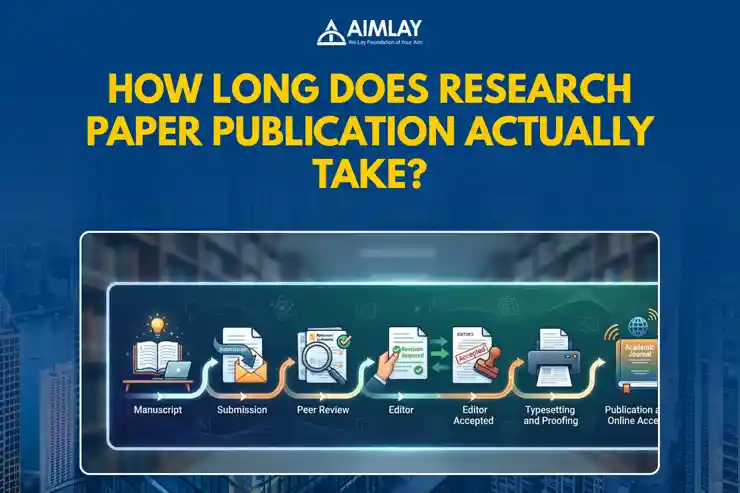
Research paper publications are not normally written in a few months and may take more than a year to be published in certain journals and in certain disciplines, depending on the review process. In this guide, we will explain each step in the publication process and what you can expect to see and plan around it.
Table of Content
• What Is the Average Research Paper Publication Time?
• What Are the Stages in the Publication Process?
• How Does the Process Take from Submission to Publication?
• Which Journals Publish Papers Quickly?
• What Causes Delays in the Research Publication Process?
• What Is the Quickest Method to Publish a Research Paper?
• What Will Happen After a Research Paper Is Accepted?
• Why Does Academic Publishing Take So Long?
• Frequently Asked Questions
What Is the Average Research Paper Publication Time?
The time from submission to publication of most papers is 6-12 months. The average publication time for all research papers in most research journals. Some of the papers move faster, in 3 to 4 months, while any other papers take 18 months or more than that, especially in which the top-tier journals are having heavy competition. There are no single fixed months; knowing that the stages which are involved will help you to set a realistic expectation.
What Are the Stages in the Publication Process?
1. Manuscript and Preparation (Weeks to Months)
Authors spend almost all writing, format, and refine their paper for weeks or months before submission. This is completely within your grasp and is not part of the equation of the “official” research publication, but it does contribute to your total “wait” time.
2. Submission and Initial Screening (1 to 4 Weeks)
After submission, editors attempt to review your paper to determine whether your paper is appropriate for the journal and has a basic quality. The papers which do not pass this stage are rejected within a week.
3. Manuscript Editor (2 to 6 Months)
This is typically the most time-consuming stage in the publishing of the research paper. Manuscript review times can vary widely depending on the reviewers who are usually busy with academics who work for free. It is going to take longer for niche subjects where reviewers are less available.
4. Author Revisions (2 to 8 Weeks)
After getting the reviewer feedback, you’ll need to revise your paper. After that, the small changes take less time, and more revision with the new data or the analysis will take a couple of months.
5. Second Review Round (Optional, 1 to 3 Months)
If your revisions are substantial, then the journal will may send your paper back to the reviewers again before making a final decision.
6. Acceptance and Production (2 to 6 Weeks)
After acceptance, your paper is copied and typeset to conform to the journal style.
7. Online First Publication and Final Publication (2 to 8 Weeks)
Now many journals are providing Online First Publication where paper will get published in the online journal first with a DOI (Digital Object Identifier) assigned before the print journal. It will allow your work to be settled sooner, even as the print copy is being typeset.
How does the Process It Take from Submission to Publication?
Let’s look at the overall research paper publication process and how long it takes each type of journal to publish from submission to publication:
| Journal Type | Typical Timeline | Notes |
|---|---|---|
| Open Access Journals | 2 to 4 months | Faster review, usually involves a publication fee |
| Traditional Subscription Journals | 6 to 12 months | Longer review cycles, print schedules add delay |
| High-Impact Journals | 9 to 18 months | Very competitive, often multiple review rounds |
| Conference Proceedings | 1 to 3 months | Quicker turnaround, review process may be lighter |
| Predatory Journals | Days to 2 weeks | Fast but lacks real peer review, avoid these |
Which Journals Publish Papers Quickly?
If speed is an issue, consider looking for these features:
• Open access journals: have quicker and more efficient review processes.
• Conference proceedings: It is published within the couple of weeks of the conference.
• Journals with transparent review timelines: It is listed on their website to let you compare options before submitting.
• Journals with continuous online publication models: You do not have to wait for a scheduled print issue.
Beware of journals that offer speedier publication than usual without providing any peer review, as these tend to be dubious, and can damage your credibility.
What Causes Delays in the Research Publication Process?
There are a few factors that can extend the time that it takes to get your research paper published:
• Subject area: There are certain subjects that have more reviewers than others.
• Finding reviewers: The most common stumbling block is getting two or three qualified individuals to agree to review.
• Manuscript quality: Poorly structured paper invites additional rounds of revision.
• Journal backlog: Sometimes journals are flooded and cannot process the appropriate number of submissions in time.
• Slow author responses: Long turnaround time for author revision; this will extend the timeline as well.
• Plagiarism or ethics screenings: If any of these are triggered, it can add a few weeks.
What Is the Quickest Method to Publish a Research Paper?
Peer review times are generally out of your control, but you can hurry it along by:
1. Selecting a journal that has a reputation for having a shorter time to manuscript review and examining their published turnaround times.
2. Make sure your paper is in proper format to not be returned to the desk.
3. Making prompt and effective responses to reviewers’ comments.
4. Post your research to preprint servers before it has been formally published.
What Will Happen After a Research Paper Is Accepted?
Acceptance is not the last; but it is the start of scratch.
1. Copy editing and formatting are performed on your paper.
2. Proof will be provided most often that you’ll need to review and approve.
3. The paper might be published as an online first issue with a DOI.
4. It’s then scheduled for inclusion in a print or final online issue.
It is the final stage, where you will know how long online publication takes after acceptance, but usually it takes 2 to 8 weeks, though it can be more quicker for the fully digital journals.
Why Does Academic Publishing Time Take So Long?
Academic publishing favors precision over haste. Peer review can take time to identify errors or to ensure that the work of your research is sound. It’s the compromise: slow publication, but a more reliable scholarly history.
Frequently Asked Questions
What is the period for the publication of a research paper?
It takes 6 to 12 months on average to publish a paper in the journal, which can take as little as 2 to 4 months in some journals, and as much as 18 months or more in others.
Do high impact journals take longer to publish papers?
Yes. The peer-review process for high impact journals is multiple times, and the publication process can take 9–18 months.
What is the quickest journal to publish in?
Search for journals that report on average review and publication times and that publish continuously online and have a clearly defined editorial process.
Are conference papers published quicker than journal papers?
Yes. One of the fastest ways to publish is conference proceedings, and it can be published within 1-3 months of the conference.
How soon after acceptance will the article be published online?
Many journals have papers that are accepted and then published online within 2 to 8 weeks prior to the final publication of the journal.
Can a paper be submitted without having to undergo the peer review process?
Yes. A manuscript may be rejected at the editorial screening phase if they do not fit within the scope and quality of the journal.
If a journal is promising to publish it within days, should I trust it?
Be cautious. Rather quick publication that comes without real peer review might be a sign of predatory journals which are not academically sound.
How can I ensure that my work is published?
Find a reputable journal that has clear review times and prepare your manuscript carefully, consider journals that publish continuously online, and be sure to respond promptly to reviewers’ comments, and consider journals with reputable open access.
What is the timeframe for authors to revise their manuscript?
Most journals will take 2-8 weeks for revision, if more than a major revision may take longer.
Are there any educational reasons for using a different type of paper?
Yes. Generally, a well written and formatted manuscript results in fewer revisions and in a faster review process.
