



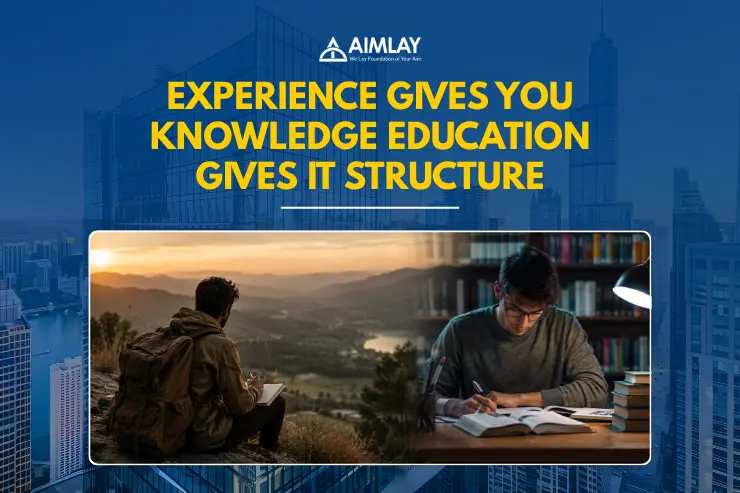
There’s a version of this debate that never goes away — is a Degree still worth it, or does real-world experience teach you more? Both sides have a point. But the framing misses something important: education and knowledge aren’t competing. They do different jobs. And understanding that difference can change how you approach your own growth.
Table of Content
• What Is Knowledge, Really?
• What Education Actually Does
• The Real Difference Between Education and Knowledge
• Why This Matters for Working Professionals in India
• Skill Development and Critical Thinking: Where Both Meet
• Frequently Asked Questions
What Is Knowledge, Really?
Experience is learned by trying. By making mistakes. By seeing what really happens when people aren’t telling you. A mechanic working on cars for ten years will know things about mechanics that you cannot find in a book. Likewise, a teacher who has worked in a classroom for fifteen years understands aspects of student behavior that no college or university education will prepare you for. That’s experience-based knowledge as unrefined and unique to each person as it is.
Practical knowledge builds up the same way. You learn to negotiate by negotiating. You develop judgment by making wrong calls and course-correcting. This kind of learning is real, but it has a limitation: it’s often fragmented. You know what worked in your situation. Applying it somewhere new takes extra work. This is where formal education steps in.
What Education Actually Does
Formal education doesn’t just hand you information. It organises it. It gives scattered insights a framework, shows you the principles behind the patterns, and trains you to think through problems rather than just react to them.
Classroom learning connects your experience to broader theory. Say you’ve been managing a team informally for years — an MBA Program doesn’t just validate what you already know. It helps you articulate it, question it, and apply it in unfamiliar contexts. That’s what theoretical knowledge is for: it extends your reach beyond your own experience.
The difference between education and knowledge in human development comes down to depth versus structure. Knowledge gives you material. Education tells you what to build with it.
The Real Difference Between Education and Knowledge
This is where most people get stuck. They treat formal education as proof of knowledge, or dismiss education because they’ve learned so much on the job. Neither view holds up.
| Aspect | Education | Knowledge |
|---|---|---|
| Source | Institutions | Experience, Observation |
| Form | Structured, Sequential | Organic, Fragmented |
| Strength | Transferable, Rigorous | Deep, Context-Specific |
| Limitation | Can Be Theoretical | Hard to Generalize |
The importance of education lies in what it does to raw knowledge — it tests it, refines it, connects it to a wider body of understanding. The importance of knowledge lies in keeping education grounded in reality. A PhD Graduate who has only read papers but never worked in their field will struggle. So will the seasoned professional who never steps back to examine why what they do works. Both need the other.
Why This Matters for Working Professionals in India
In India, this tension shows up constantly. Lakhs of working professionals carry years of practical experience in fields like management, healthcare, law, and engineering — but lack formal credentials. On the flip side, fresh graduates often hold degrees without the experiential knowledge that employers actually want.
The good news is this gap doesn’t have to be permanent.
Platforms such as Aimlay understand that learning does not occur in a “one size fits all” fashion. The Approach of Aimlay will be specific to individuals who are currently working professionals with many years of practical experience — and now wish to receive formal education to provide their knowledge structure, credibility, and career leverage. Whether you are interested in pursuing postgraduate degree opportunities (e.g. PhD), undergraduate/postgraduate degree opportunities or graduate management studies; the goal is to combine your existing knowledge base with an educational framework that supports and expands this body of knowledge.
Skill Development and Critical Thinking: Where Both Meet
The best outcomes happen when education and knowledge reinforce each other.
Skill development is a good example. You can read about communication theory, but you build communication skills by using them under pressure. Education gives you the vocabulary and models; knowledge gives you the practice ground.
Critical thinking skills work the same way. They don’t emerge just from reading or just from doing — they come from being forced to test what you believe against evidence, structure, and opposing views. Classroom learning does this deliberately. Experience does it chaotically. Together, they produce someone who can actually think, not just recite or react.
This is why the education vs knowledge framing is a false choice. The question isn’t which matters more. It’s how to make sure each strengthens the other in your own learning journey.
Experience builds knowledge that no curriculum can replicate. But without structure, that knowledge stays locked inside one context, one industry, one way of seeing. Education is what takes what you know and makes it portable.
If you’re a working professional sitting on years of hard-won expertise and wondering whether formalizing it makes sense — it usually does. And you don’t have to start from scratch. Platforms like Aimlay are built around the idea that your experience already counts. The right programme just helps you prove it.
Frequently Asked Questions
What is the difference between education and knowledge?
Education is a structured process of learning delivered through institutions, curricula, and formal qualifications. Knowledge is gained through experience, observation, and practical application. While education provides a framework for learning, knowledge gives real-world understanding. Ideally, both work together to create deeper expertise and personal growth.
Why is education important even when you already have experience?
Education goes beyond earning a degree. It helps individuals think systematically, communicate expertise effectively, and apply knowledge across different situations. For working professionals, formal education often transforms years of experience into recognized qualifications that support career advancement, research opportunities, and leadership roles.
What is experiential knowledge and how is it different from theoretical knowledge?
Experiential knowledge is gained through hands-on experience, fieldwork, and real-world decision-making. Theoretical knowledge comes from research, models, frameworks, and academic study. Experiential knowledge is highly practical and context-specific, while theoretical knowledge can be applied across various situations. Both are valuable and complement each other.
How does formal education develop critical thinking skills?
Formal education encourages learners to evaluate evidence, analyze different viewpoints, support arguments with credible sources, and defend conclusions. This process strengthens critical thinking, problem-solving, and decision-making abilities that extend beyond memorizing facts.
Can practical knowledge replace classroom learning for career growth?
Practical knowledge is essential, but it does not fully replace formal education. Employers often value a combination of hands-on experience and academic qualifications. Classroom learning broadens perspectives and introduces concepts that may not be encountered through work experience alone.
How do education and knowledge contribute to human development?
Knowledge helps individuals understand and navigate their daily experiences, while education connects those experiences to broader scientific, historical, social, and philosophical perspectives. Together, they enable people to solve problems, adapt to change, contribute to society, and support long-term personal and professional development.
