



People think that as long as they’re really good at what they do, they’ll be recognized. Skill is a key factor, but sometimes real-world experience tells a different story. In business, school, work, creative professions, sports and as entrepreneurs, many great people are overlooked, and some not so great are celebrated.
The solution is that skill recognition is distinct from accomplishments. One is a matter of capability and the other is a matter of visibility. It is important, but it’s important for different reasons for personal and professional success.
Table of Content
• Understanding Being Skilled
• Understanding Being Recognition
• The Core Difference: Being Skilled vs Being Recognized
• Why Highly Skilled People Often Remain Unrecognized
• Why Recognition Matters
• The Danger of Recognition Without Skill
• The Ideal Balance: Skill Plus Recognition
• Practical Ways to Gain Recognition Without Losing Authenticity
• Common Myths About Skill and Recognition
• The Modern Reality
• Final Thoughts
• Frequently Asked Questions
Understanding Being Skilled
Skill can be defined as having knowledge, expertise, experience, and the ability to do something well. Skill develops from learning, practice, repetition, discipline, and self-improvement.
A skilled person:
1. Has a strong knowledge of their trade.
2. Consistently produces high quality work.
3. Solve problems efficiently.
4. Continue learning and training.
5. Concentrates on achievement instead of focus.
Most of the skill is a private asset. It is there whether or not people are conscious of it.
For instance, a software developer can write good code, a designer can design great visuals, and a writer can produce great content. Even if not many people know about their abilities, it remains valuable.
Understanding Being Recognition
The act of others acknowledging another’s capacities, contributions, achievements, or influence.
There are many ways to get recognition:
. Promotions
. Awards
. Public appreciation
. Industry reputation
. Social media following
. Professional opportunities
. Leadership positions
. Increased demand for services
Recognition is based on outside influences, unlike skill. It demands that others perceive, comprehend, and appreciate your worth. Recognition is not only about being good at something, but also about letting others know that you are good at something!
The Core Difference Being Skilled vs Being Recognized
| Aspect | Being Skilled | Being Recognized |
|---|---|---|
| Definition | Having expertise and capability | Receiving acknowledgment from others |
| Focus | Competence | Visibility |
| Source | Internal development | External validation |
| Built Through | Practice, Learning, Experience | Communication, Exposure, Reputation |
| Control Level | Mostly within your Control | Partially influenced by others |
| Measurement | Quality of Work | Public Awareness and Appreciation |
| Value | Creates capability | Creates opportunities |
| Longevity | Usually Long-lasting | Can Increase or Decrease over Time |
Why Highly Skilled People Often Remain Unrecognized
One of the biggest misconceptions is that excellence automatically attracts attention.
In fact, many skilled Professional People are undetected because they:
1. Avoid Self-Promotion
There are some people that think their work should speak for itself. Quality work is necessary, but no one can appreciate what he or she has never seen. One of the most important things is visibility for recognition.
2. Lack Networking Opportunities
Relationships often are how you get recognized. Networking is the best way to connect with people that will offer you opportunities that you may not have heard of.
3. Work Behind the Scenes
Many experts work in non-prominent positions, and they make important but not a prominently visible contribution.
4. Fail to Communicate Their Value
You must be able to do a good job, and you must be able to tell people how valuable you are. There are lots of individuals who are super talented who have a problem with presenting their talents really well.
5. Wait for Recognition Instead of Creating It
There are those who believe that recognition will just come with the job. Others proactively share their knowledge via content, presentations, leadership, and engagement in the public domain.
Why Recognition Matters
Others do say that it’s all about skill. But in professional development, recognition is an important factor. When recognized, it will cause:
. Better career opportunities
. Higher income potential
. Greater influence
. Stronger professional credibility
. Expanded networks
. Access to leadership roles
. Business growth
Abilities may still be the same, and a highly skilled professional may be in the same role for years, but a recognized professional may increase opportunities just because more people recognize the value of his or her skills. Skill is multiplied by recognition.
The Danger of Recognition Without Skill
Recognition can be a tool to create opportunities; it can be dangerous when it is more than what the person can do. When you’re recognized without the proper skills management, you may experience:
. Loss of credibility
. Poor performance
. Short-term success
. Damaged reputation
. Difficulty sustaining growth
There are lots of people who can gain attention in the short term, but only those who have real skill recognition are going to be successful in the long run. To get into a door, recognition is necessary, but skill will keep the door open.
The Ideal Balance: Skill Plus Recognition
The most successful individuals combine both.
. Continuously improve their expertise.
. Share their knowledge publicly.
. Build professional relationships.
. Document their achievements.
. Create value consistently.
. Make their work visible.
This synergy forms a strong feedback loop:
Skill → Results → Visibility → Recognition → Opportunities → More Skill Development
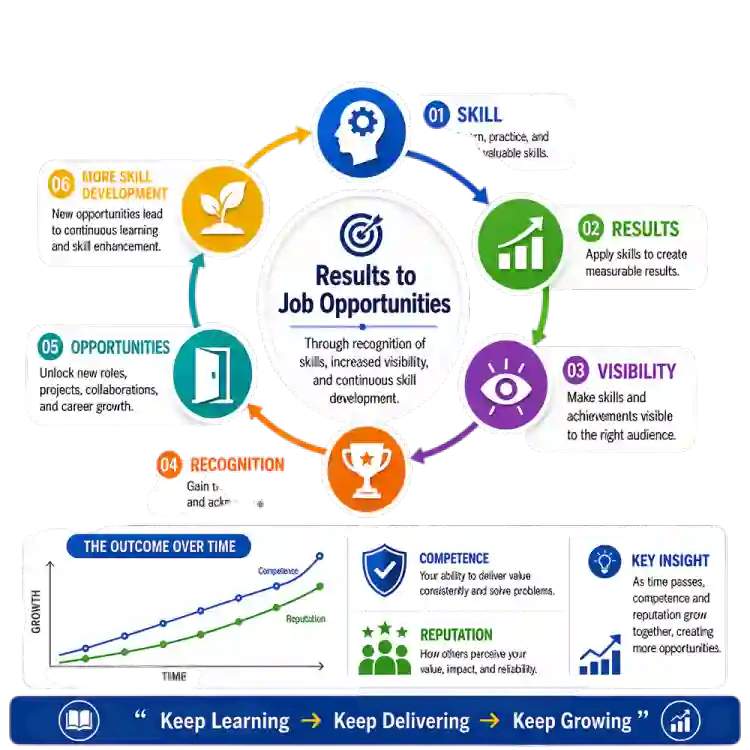
Results to job opportunities through recognition of skills, increased opportunities for skill development, and increased skill visibility.
As time goes on, competence and reputation will develop together.
Practical Ways to Gain Recognition Without Losing Authenticity
Self-promotion is something many people don’t like, as it makes them feel uncomfortable or boastful. But it doesn’t need to be arrogant to be recognized. Here are healthier ways to become visible:
1. Share Your Work
Share projects, case studies, articles, research, or accomplishments that show your knowledge and/or skills.
2. Help Others
Learning, mentoring, and sharing are a growth process of credibility.
2. Build a Professional Network
Meaningful relationships often create opportunities that skill alone cannot generate.
3. Speak About Your Achievements
Discuss accomplishments factually rather than exaggerating them.
4. Create Consistently
The effective establishment of visibility is not a simple one-shot affair. Trust and recognition will be developed over time consistency is key.
5. Develop Communication Skills
Often, being able to communicate your ideas in an understandable way can lead to more recognition than technical expertise.
Real-World Examples
Over the years and even in modern business, there are many gifted people who never received recognition during their life while others did become known, simply because they were able to communicate their work, or they were placed in a position where people would be able to see their work.
. In the same way, in the workplace today:
. You can have one worker quietly produce great work.
A different staff person can be very effective in delivering results and also in presenting updates, sharing successes and establishing relationships.
The second person usually gets more recognition, although this isn’t always because they’re more talented, it’s because they’re more obvious.
Common Myths About Skill and Recognition Skill
Myth 1: Good Work Always Gets Noticed
Not necessarily, it is often the visibility that provides good work attention
Myth 2: Recognition Means You Are More Skilled
Skill and Recognition are related but not the same. There are lots of very talented folks, not everyone who is skilled gets recognized as such.
Myth 3: Self-Promotion Is Always Bad
It is not an arrogance to share real accomplishments and knowledge. It gives others an insight into the value you offer.
Myth 4: Recognition Is All About Luck
Luck is often involved, but you cannot act on luck; continuous visibility or networking and communication certainly boosts recognition.
The Modern Reality
Due to the advancement in technology, recognition is easier than ever before nowadays. Professionals can build visibility through:
. Personal websites
. Professional communities
. Social platforms
. Industry events
. Content creation
. Online portfolios
. Public speaking
That means skill is no longer sufficient. The smartest people are often the most visible, and this combination gives them an unfair advantage. The problem is not the choice between skill and recognition. The challenge is developing both.
Final Thoughts
Having skill does not mean you automatically get recognized. Skill is your ability to create value. Recognition is what society gives that value. One is internal, the other is external. Competence is harnessed through skill, while recognition leads to opportunity. Neither should be ignored. Without skill recognition becomes fragile. Good Skill is usually unutilized without recognition.
The most successful people recognize that mastery and visibility are partners, not competitors. They spend time getting really good at what they do but also making sure that it gets to the eyeballs needed. Ultimately, being a talent or celebrity is not the answer! Meaningful value is what we aim for and to make that even work; it has first land somewhere.
Frequently Asked Questions
What is the difference between being skilled and being recognized?
Being skilled means possessing the knowledge, experience, and expertise needed to perform a task effectively. Recognition, on the other hand, is the acknowledgment and appreciation received from others. Skill reflects competence, while recognition reflects visibility.
Can someone be highly skilled but not recognized?
Yes. Many talented professionals, entrepreneurs, artists, and employees remain unnoticed because of limited visibility, networking opportunities, or self-promotion. Skill alone does not always guarantee recognition.
Is recognition more important than skill?
Neither is more important than the other. Skill creates value and capability, while recognition helps create opportunities and influence. Long-term success usually requires a balance of both.
Why do some less skilled people receive more recognition?
Recognition often depends on communication skills, networking, personal branding, visibility, and exposure. Individuals who actively showcase their achievements may gain more recognition than equally skilled people who remain behind the scenes.
Does good work always get recognized?
Not always. While quality work is essential, recognition often depends on whether the right people notice and understand your contributions. Visibility and effective communication play a major role in gaining acknowledgment.
The Difference Between Being Skilled Vs Being Recognized
Learn why skill alone isn’t enough for career growth. Discover how recognition, visibility, communication, and personal branding work together with expertise to create long-term professional success.
