



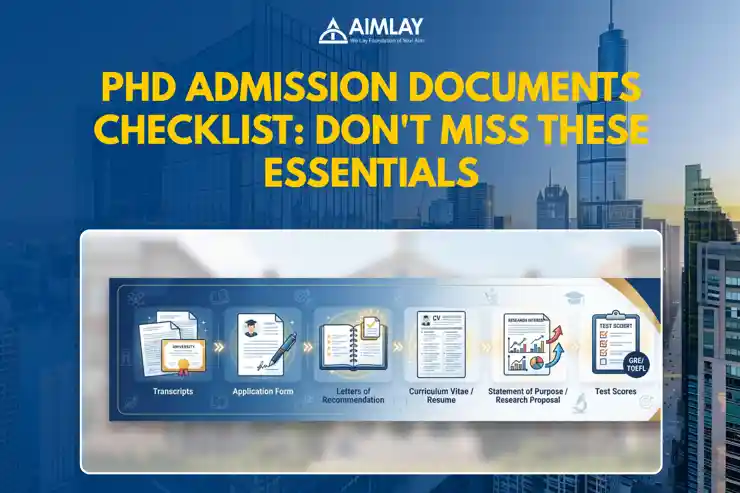
Losing one document during the PhD application process could cause an applicant to miss their entire cycle of admission. It should be easy enough to determine what documents are needed for PhD admission in India, since they will be the same for all applicants; however, there seems to be many more than expected. Additionally, the requirements for the different types of institutions (central universities, IITs and state) may differ.
The basic list of items that make up this checklist include academic records, test scores, a research plan/thesis proposal, identification verification, and documentation from current employer verifying work status (if an individual is working on a part-time basis).
Moreover, each item will need to have been either authenticated by the issuing authority, or the applicant will need to provide a self-attestation as deemed necessary by the institution. Here is a complete list of documents required for PhD admission in India which has been reviewed by our organization and updated as recently as possible.
Table of Content
• Additional Documents for Reserved Category and Working Professionals
• PhD Admission Process Step-by-Step in India
• PhD Without NET and PhD While Working: What Changes?
• Common Document Mistakes and How to Avoid Them
• Conclusion
• Frequently Asked Questions
Core Documents Required for PhD Admission in India
Documents required for PhD admission fall into five categories. Every institution requires all five. Furthermore, originals are usually required at the interview stage even if scanned copies suffice for the online application.
Academic Certificates
• 10th mark sheet and certificate
• 12th mark sheet and certificate
• Bachelor’s degree mark sheets (all semesters) and provisional/final certificate
• Master’s degree mark sheets (all semesters) and provisional/final certificate
• Migration certificate (if applying to a different state university)
Entrance and Test Scores
• UGC-NET / CSIR-NET / GATE scorecard (if qualified)
• University entrance test admit card and scorecard (where applicable)
Identity and Address Proof
• Aadhaar card (mandatory for most Indian universities)
• Passport-size photographs (6–8 copies, recent)
• Valid passport (if applicable for international programs)
Research Proposal
• Synopsis of proposed research (2–5 pages, topic, objectives, methodology, bibliography)
• Subject-specific research statement (some IITs and central universities require this separately)
Other Standard Documents
• Character certificate from last institution attended
• Gap year affidavit (if there is a break between degrees)
• Caste/category certificate if claiming reservation (SC/ST/OBC/EWS)
Additional Documents for Reserved Category and Working Professionals
PhD admission document list for reserved category candidates and working professionals includes extra items beyond the standard set.
Reserved Category Candidates
• SC/ST certificate issued by competent authority (Tehsildar or above)
• OBC Non-Creamy Layer certificate — must be valid for the current financial year
• EWS certificate — issued in the prescribed format for the current year
• PwD certificate — from a government medical board
Working Professionals (Part-Time PhD)
• No Objection Certificate (NOC) from current employer — mandatory without exception
• Service certificate or employment letter confirming current designation and tenure
• Experience certificate if the institution counts experience toward eligibility
All NOCs should be on the official letterhead of the organisation with a signature of an authorised signatory who confirms that the student has a go ahead to pursue their PhD course. Some institutes require that the NOC be produced prior to interviews and not at the time of admission.
PhD Admission Process Step-by-Step in India
PhD admission process in India follows a consistent sequence under UGC Regulations 2022.
1. Notification — universities publish PhD admission notifications typically between January–March and July–September
2. Application — submit online through the university portal with scanned documents
3. Entrance test — appear for university-specific test (if not NET/JRF qualified)
4. Research aptitude interview — defend your research proposal before a panel
5. Merit list — selection based on 70:30 (test:interview) for non-JRF candidates; interview alone for JRF holders
6. Document verification — originals verified at the institution
7. Enrollment — fee payment and formal registration
PhD process step-by-step in India does not vary significantly between institution types. However, document submission deadlines differ. Therefore, keep all documents ready at least two weeks before the application deadline.
PhD Without NET and PhD While Working: What Changes?
PhD Without NET
How to do PhD in India without NET is possible at state universities and private deemed universities that conduct their own entrance tests. The document checklist remains identical. However, you replace the NET scorecard with the university’s entrance test scorecard. Furthermore, some institutions accept GATE scores in lieu of NET for engineering and science programs.
PhD While Working
How to do PhD in India while working requires one additional document not needed by full-time candidates: the employer NOC. Without it, no institution under UGC Regulations 2022 will process a part-time PhD application. Therefore, obtain this before applying — not after receiving a call for interview.
Common Document Mistakes and How to Avoid Them
PhD admission documents checklist errors that cause delays:
• Submitting mark sheets without the degree certificate — both are required separately
• OBC certificate not updated for the current year — non-creamy layer status must be certified annually
• NOC without authorised signature — a rubber stamp alone is not sufficient
• Research proposal too vague — examiners reject proposals without a clear gap, objectives, and methodology
• Gap year not explained — any gap between degrees must be covered by an affidavit
Furthermore, certain institutions may require a self_declaration that you will meet the mandatory residential requirement (typically six months over the course of the program). Therefore, before applying to a specific institution, make sure to review its residential requirements.
Aimlay supports doctoral candidates through the application stage — reviewing documents, preparing research proposals, and ensuring submissions meet the specific requirements of the target institution. Therefore, if you are applying to multiple universities simultaneously, structured support prevents avoidable delays.
Conclusion
The individual components of a PhD Application in India (academic certificates, entrance test scores, etc.) are straightforward to complete. However, when one is absent — most notably the No Objection Certificate for working professionals or a current OBC certificate — the application will be terminated prior to its beginning. Document quality is also important; just as with document completion.
Summary of PhD Admission Documents Checklist India: Academic Credentials, Entrance Test Scores, Research Proposal, Identification Proof, Category Certification If Applicable, and Employer’s Letter of Clearance If Part-Time Applicant. All applicants should prepare their documentation at least two weeks prior to submission deadlines. Originals of these documents must remain available during the entire review process.
Frequently Asked Questions
What documentation is needed for PhD admission in India?
The following documentation is required for a PhD admissions process in India:
• Academic certification of education from 10th grade to completion of Master’s degree;
• A valid NET/ GATE / University Test Score Card;
• A Research Proposal Synopsis;
• Valid Identity Proof;
• Character Certificate;
• Gap Certificate if Applicable;
Additional documentation may be requested by institutions offering PhD programs for Working Professionals and Reserved Category Candidates.
Is there a PhD admission documents checklist PDF available?
PhD admission documents checklist PDF is published by most universities in their official admission notification. Furthermore, UGC and Shodhganga also publish general guidelines. Therefore, always use the institution-specific checklist — requirements vary and the general list may not cover all institutional demands.
What is the PhD admission process step-by-step in India?
Step by Step for the PhD Admission Process in India
1. Notification for PhD admissions.
2. The candidate needs to fill an online form with all his/her academic credentials and submit them along with other necessary documents.
3. Entrance Test. Depending on the institute or department this may be a part of the selection process. Candidates who are qualified through JRF can avoid the written examination and will have direct access to the Research Aptitude Interview.
4. Merit List. A merit list will be prepared based upon performance in the entrance exam. If there was no entrance test then the merit will be solely based on previous marks.
5. Document Verification. All candidates selected will have their academic credentials verified prior to being allowed to enroll into the PhD program.
Can I do a PhD in India while working?
How to do PhD in India while working is possible through the part-time PhD framework under UGC Regulations 2022. The key additional document is the employer NOC. Furthermore, you must meet the institution’s mandatory residential requirement — typically six months over the program duration.
How to do PhD in India without NET?
How to do PhD in India without NET is possible at state universities and private deemed universities that conduct their own entrance exams. You submit the university entrance test scorecard in place of a NET scorecard. GATE scores are accepted as an alternative at engineering and science institutions.
How many documents are required to apply for a PhD program in India?
The number of documents required to apply for a PhD program in India may vary depending on the university/college you have applied to; however, a basic application package usually consists of twelve to eighteen documents. Additional documentation is required from reserved categories or working professionals (three to five additional documents).
Must I write a research proposal as part of my application process?
Yes. Almost all universities require a synopsis of your proposed research in a format that will be approximately two to five pages long including: topic, identified research gaps, stated objectives, outlined methodologies, and a bibliography. Write this prior to submitting an application – do not wait until after being invited for an interview.
How to do a PhD after 12th in India?
How to do PhD after 12th requires a Bachelor’s degree followed by a Master’s degree. Alternatively, a four-year Bachelor’s with 75% marks qualifies for direct PhD under UGC 2022. Therefore, a PhD is not directly accessible after 12th — undergraduate completion is required first.
Is the entrance exam for PhD mandatory in India?
Entrance exam for PhD is required unless you hold UGC-NET JRF or CSIR-NET JRF qualification, which exempts you from the written test at most institutions. Furthermore, GATE score is accepted as equivalent at engineering institutions. Therefore, entrance exam exemption depends on the qualification you hold, not on the institution’s preference.
What is the NOC and when is it required?
The No Objection Certificate (NOC), which must be provided by all current employers of those wishing to pursue part-time doctoral studies at UGC (University Grants Commission)-regulated education providers (as stated in the 2022 UGC Regulations) before an interview takes place for PhD admissions. In addition to a representation from the employer being signed, the employer’s NOC must be on official letterhead, as well as contain clear language stating that they have no objections to their pursuing a Doctoral degree, and may additionally detail conditions if necessary.
If you are looking to submit your application for a PhD in India and would like some guidance with either document submission or research proposal development please visit www.aimlay.com our Academic Mentors will guide you through the complexities of applying for PhD programs.
