



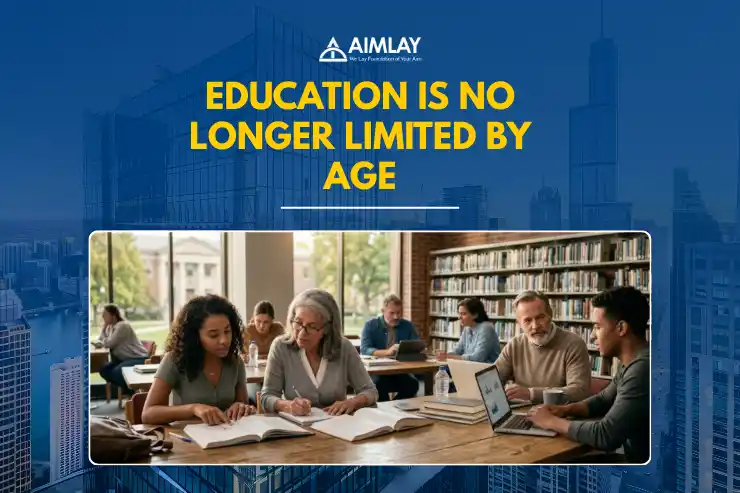
The short answer: education has no age limit, and the numbers are proving that. 1 in every 5 Americans over 25 plans to return to school within a year; & almost twice as many (34%) have long-term plans of returning. 82% of professionals globally priorities ongoing upskilling for job security. More than one in five adults who plan on going back to learn next year will be doing so because of what is happening with artificial intelligence. While some people may go back because they are afraid, most recognize that if you want to stay ahead of what is changing around you learning never stops. According to the top reasons why adults decide to continue their education include: higher pay (64%), personal fulfillment (51%), career change (31%), etc. While “it’s never too late” can be said as an encouragement, it is becoming true for huge numbers of adults.
Table of Content
• Learning Has No Age Limit: What the Research Shows
• Online Learning for Adults: What Has Changed
• Is It Too Late to Get a Degree?
• Benefits of Learning New Skills as an Adult
• How to Start Studying Again as an Adult
• Conclusion
• Frequently Asked Questions
Why Adults Are Returning to Education Now
It’s no longer true that adults can only pursue continuing education. Continuing education has become a standard way people respond to an ever changing workforce.
The World Economic Forum (WEF) Future of Jobs Report 2025 noted that technology was the largest creator of jobs and displacers of jobs – even larger than the influence of any other economic trend. This rate of change will continue. An adult who finished school in the 1990s or early 2000s is working in a completely new industry compared to when he/she/they graduated.
In this type of economy, continuing education isn’t just because “you didn’t do well” in your initial educational experience. It is primarily because there weren’t any resources available for you to learn about these topics. In many cases, the skills needed by employers today have never been part of a curriculum, let alone one developed in the last decade. Going back to the classroom is not going backwards; it is simply getting caught up with what really exists in the workplace.
Learning Has No Age Limit: What the Research Shows
It’s no longer true that adults can pursue continuing education. Continuing education has become a standard way for people to respond to an ever-changing workforce.
The World Economic Forum (WEF) Future of Jobs Report 2025 noted that technology was the largest creator of jobs and displacers of jobs – even larger than the influence of any other economic trend. This rate of change will continue. An adult who finished school in the 1990s or early 2000s is working in a completely new industry compared to when he/she/they graduated.
In this type of economy, continuing education isn’t just because “you didn’t do well” in your initial educational experience. It is primarily because there weren’t any resources available for you to learn about these topics. In many cases, the skills needed by employers today have never been part of a curriculum, let alone one developed in the last decade. Going back to the classroom is not going backwards; it is simply getting caught up with what really exists in the workplace.
Online Learning for Adults: What Has Changed
Online learning for adults has changed more in the last four years than in the previous twenty. The structural barriers that made adult education difficult — needing to be physically present, fitting into schedules designed for full-time students, accessing course materials only on campus have largely been removed.
E-learning platforms 2026 now offer:
| Format | What It Means for Adult Learners |
|---|---|
| Self-paced courses | Complete modules on your schedule, not the institution’s |
| Hybrid degree programs | Campus attendance required only for key assessments or residencies |
| Micro-credentials | Stackable qualifications that build toward formal degrees |
| Live online cohorts | Structured peer learning without geographical constraints |
| AI-supported personalization | Content adapted to existing knowledge level and pace |
While there are some who still question if distance learning can ever provide both flexibility for adult students and quality education, this is no longer an issue since most countries now allow degree programs accredited by recognized accrediting bodies to be considered equal to campus-based degree programs.
In addition to the convenience of being able to attend classes online as they are available, adult students also can take advantage of being able to continue working while pursuing their studies, meet their family responsibilities and apply what they learn in a course to their job immediately.
Is It Too Late to Get a Degree?
Is it too late to get a degree? No, and this question almost always rests on an assumption worth examining: that a degree is only worth pursuing if it produces the full career arc it might have at 22.
That assumption is wrong. Degree programs for working adults are not designed to replicate an 18-year-old’s trajectory. They are designed to add verifiable depth, credibility, and qualification to a professional who already has experience. The combination of real-world context and formal academic credentials tends to be more valuable than either alone.
70% of adults in a 2025 survey said employer support — through tuition assistance or flexible scheduling — would make them more likely to pursue additional education. That figure reflects how mainstream adult education has become as a career strategy, not an exception to normal professional development.
Benefits of Learning New Skills as an Adult
Benefits of learning new skills as an adult are specific, not generic:
• Career security and income: Higher pay drives 64% of returning learners; 21% cite AI disruption as the direct trigger
• Skill development for career growth: Structured programs produce formal credentials that experience alone does not
• Cognitive and personal benefits: OECD and UNESCO research links adult learning to cognitive health and fulfilment 51% of returning learners name personal fulfilment alongside career goals
• Lifelong learning works best when aligned to a specific direction. Adults who know what gap they are closing complete programs at significantly higher rates than those returning with undefined goals.
Aimlay works with working professionals navigating exactly this: choosing the right postgraduate or doctoral program, managing the admission and research stages, and completing a qualification that reflects their actual professional level — not just the years they have been working.
How to Start Studying Again as an Adult
Although returning to study after adulthood may seem daunting, there are many ways to begin. The biggest challenge for most people is not logistics – but rather the internalized belief that it’s simply too late to begin.
Practical first steps:
• Identify the specific gap. What does the qualification need to do open a specific role, deepen specific expertise, or satisfy a specific institutional requirement?
• Evaluate the qualifications’ legitimacy. To ensure that formal credentials are valid, verify they have been accredited by the University Grants Commission (UGC) in India and/or by their respective country’s accrediting body.
• Start with an option that can fit into your own routine. It’s much easier to complete a part-time hybrid/online degree that works around your present job as opposed to competing with it.
• Start with an option that can fit into your own routine. It’s much easier to complete a part-time hybrid/online degree that works around your present job as opposed to competing with it.
What are the best online course options for adults over 30, 40, and 50? They aren’t necessarily determined by a single website or online platform. The best programs are those that create a good fit with both the program format/structure and the recognized certification/diploma and the adult learners’ specific goals.
Conclusion
Education is now available to people regardless of their age in how they are able to take advantage of education through structure, logistics, as well as in what a person can achieve from an educational standpoint when they begin with an education at the age of 35, 45, or 55. Adult online education, degree programs that are part hybrid as well as the many options to obtain credentials will remove some of the previous barriers that caused adult education to be more of an exception rather than the rule.
It’s never too late to learn is not the end of the argument — it is the beginning of a decision. The question is not whether education is possible at any age. It clearly is. The question is which program, from which institution, aligned to which professional goal.
That is where the thinking should start.
Frequently Asked Questions
Does education really have no age limit?
Education does not have an age limit — neither structurally nor in its benefits. According to OECD’s Education at a Glance 2025, there are quantifiable gains from post-secondary education (i.e., adult education) on both economic and social outcomes (e.g., employment rates & cognitive health). One in five adults over 25 report they will go back to school sometime within the next 12 months. It is not simply a niche option; it is becoming a standard component of many individuals’ career strategies.
Is it too late to get a degree as a working adult?
Is it too late to get a degree? No. Programs specifically developed for working professionals are intended to build upon their existing professional experience with formal academic credentials rather than replace them. The value of combining real world experience with academic credentials seems greater than each individually, whether those degrees were earned early or later in life.
What are the real benefits of online learning for adults?
Advantages of online education for adults include flexibility so adults can continue working, application of knowledge in real-time to an adult’s present job, access to accredited programs where geography would normally restrict participation, and formal credentials which possess equal status to traditional campus based degrees when provided by accredited institutions.
How does continuing education help with career growth?
Continuing education closes the gap between what current skills allow and what evolving roles require. 64% of returning adult learners are driven by income growth and 21% by job security concerns related to AI both point to education as a direct career strategy, not a personal hobby.
How to start studying again as an adult without it being overwhelming?
How to start studying again as an adult: identify the specific credential gap you are closing, verify accreditation, choose a program that fits around current commitments, and get employer clarity early. Most adult learners who complete programs are the ones who started with a specific goal rather than a general intention to “keep learning.”
What is the difference between distance learning and traditional education for adult learners?
Distance learning vs traditional education for adults is no longer a quality trade-off. Accredited online and hybrid programs now carry equivalent recognition to campus-based degrees in most countries and under UGC-DEB regulations in India. The difference is logistical distance learning fits around an existing career rather than requiring you to step away from it.
Considering a postgraduate or doctoral program that fits around your career? Visit aimlay.com to explore UGC-recognised programs designed for working professionals at any stage.
