



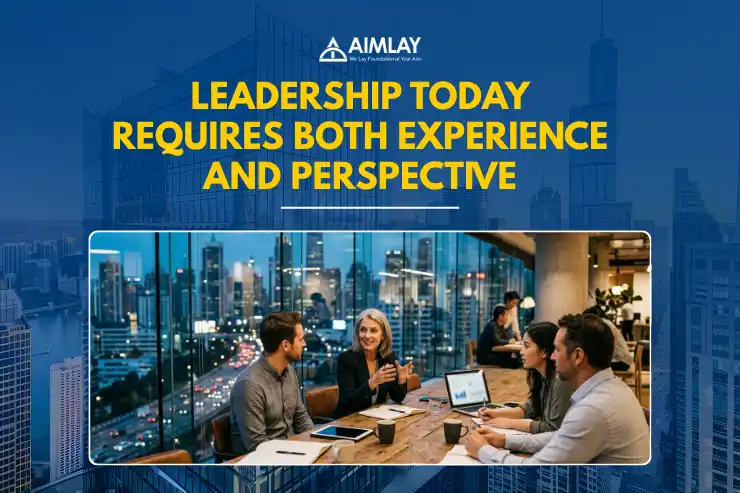
With the rapid changes in this world, experience is no longer the key to effective leadership. The most effective leaders of today have gained a wealth of knowledge from years of hard work and have also developed a constantly changing view, one that is driven by lifelong learning for leaders, curiosity and a resolve to learn. The combination of experience and perspective will set good leaders apart from transformational leaders, both in a startup and a global enterprise.
Table of Content
• How Does Lifelong Learning Improve Leadership?
• Experience vs. Perspective: Why Both Matter
• What Are the Habits of Successful Leaders?
• Why Is Continuous Learning Important for Leadership?
• How Can Leaders Develop a Growth Mindset?
• What Skills Should Future Leaders Learn?
• How Does Experience Complement Perspective in Leadership Today?
• Frequently Asked Questions
Why Should Leaders Be Lifelong Learners?
Leaders’ context is always changing. New technologies come and go, markets change, and team expectations adjust. An organization with a stagnant mind is a danger to being left behind, as is a leader who stops learning and ceases to grow.
There is no such thing as being too old to learn, and no such thing as a leadership profession for which it is not a professional obligation. Here is why:
• It continuously helps leaders remain agile in a world of disruption.
• It fosters empathy through diverse experiences and perspectives for leaders.
• It exemplifies a learning mindset that can be useful for high-performance teams to grow.
• It keeps leadership skills in line for all levels in the career cycle.
• It adds to the growth of a leader by ongoing development, not length of time in place.
How Does Lifelong Learning Improve Leadership?
• Leadership is enhanced by the acquisition of new concepts from other fields of study, which in turn enhances critical thinking.
• When leaders are exposed to new ideas across disciplines, critical thinking is enhanced.
• The quality of communication increases when leaders gain insight into the way various individuals process information.
• To sum up, leadership is lifelong learning; it is one of its most tangible forms.
Experience vs. Perspective: Why Both Matter
Many organizations advance leaders in accordance with experience alone. Experience is priceless, but it has to be accompanied by a changing point of view in order to deliver outstanding leadership results.
| Dimension | Leader with Experience Only | Leader with Experience + Perspective |
|---|---|---|
| Decision Making | Relies on past patterns and proven methods | Blends historical insight with fresh, contextual thinking |
| Team Development | Focuses on replicating what worked before | Nurtures diverse strengths; builds lifelong learning habits |
| Adaptability | May resist change when disruption arises | Embraces continuous learning and adjusts rapidly |
| Innovation Culture | Values stability and established processes | Encourages experimentation and growth mindset in leadership |
| Long-term Vision | Anchored in what the organization has done | Shaped by learning trends, emerging opportunities, and broader purpose |
| Professional Growth | Growth tapers once seniority is achieved | Prioritizes continuous education for professionals at every stage |
The numbers clearly say that leadership development is best complemented when experience and perspective work in concert.
What Are the Habits of Successful Leaders?
The skills that make good leaders consistently perform positively in their respective fields have been identified as learning habits. Learning habits are the skills that good leaders display consistently across industries. But these habits do not happen by chance, they are developed over a long time, sometimes over decades.
Daily reading: How does reading help the leadership development? It broadens context, sharpens the analytical thinking, and exposes the leaders to lived experiences beyond their own.
Mentorship and reverse mentorship: Successful leaders both who are seeking guidance from their seniors and actively learn from the younger team members.
Why Is Continuous Learning Important for Leadership?
Continuous learning is important to leadership because there’s a shorter shelf life for each individual skill set. Factors that made a person a good leader five years ago might not be enough now. This can be resolved directly with leadership development through continuous learning as it does the following:
• Identifying and filling gaps in information before they become strategic blind spots.
• Supporting teams’ professional development through leaders’ modelling of the behavior.
• Creating cultures in organizations that value and nurture curiosity and improvement, rather than performance.
Leaders who are advocates for lifelong learning foster a place where individuals don’t fear asking questions, trying things out, and adding another iteration, key traits for sustained success.
How Can Leaders Develop a Growth Mindset?
A growth mindset toward leadership is the idea that capabilities and the intelligence of leaders are not inborn but can be cultivated with hard work and commitment. The mindset of leaders is developed through:
• Willingly looking for problems that push current limits.
• Praising their team’s efforts and learning progress, rather than the results.
• Taking lifelong learning as a principle for professionals is important.
A growth mindset leader doesn’t just set up the tone; they influence the entire culture of an organization to one possibility.
What Skills Should Future Leaders Learn?
Education for tomorrow’s leaders should not be limited to skills. The following are the top 10 leadership skills that are expected to be needed in the next 10 years:
• Digital and data literacy: Knowing how to use technology without being a technologist is important.
• Emotional intelligence: The ability to read, understand, and manage emotions — one’s own and others’.
• Systems thinking: Seeing how parts connect and influence each other rather than viewing issues in isolation.
• Inclusive leadership: Building teams where diverse voices are heard and valued.
• Adaptive communication: Tailoring messages effectively across generations, cultures, and contexts.
There are websites like LinkedIn Learning, edX and Coursera that have clear and defined tracks to build these skill areas. How does it make sense that good leaders always have more to learn? They know that once they think they’ve gotten where they are, they may fall out of favor.
How Does Experience Complement Perspective in Leadership Today?
Leaders develop scar tissue from experience to deal with complexity. Their wisdom comes from a sense of perspective; when the old solutions do not address new problems. They create a grounded and adaptable leader.
The people whose leadership is held in highest esteem always possess:
• A solid number of years in practice which is open to being challenged with new trends.
• A strong background in a field with interest in related fields and concepts.
Frequently Asked Questions
Why is it that continuous learning is essential for leadership?
It fills in skills gaps before they start to become vulnerabilities and fosters cultures of curiosity and growth in organizations.
In what ways is lifelong learning an asset for leadership?
It enhances decision making processes, increases understanding of others, stimulates innovation, and keeps leaders effective in evolving situations and issues.
How can successful leaders never stop learning?
They know that leadership is not a point that is reached; it is a journey towards it; it is a process of growth, adaptation, and constant self-investment.
What are the platforms for lifelong learning of leaders in India?
Organized programmes from SWAYAM, NPTEL, IGNOU, Coursera, edX and LinkedIn Learning are available to cater to the needs of working professionals and aspiring leaders in a structured and flexible manner.
What is the difference between a growth mindset and fixed thinking in leadership?
A growth mindset sees challenges as an opportunity to grow; a fixed mindset sees challenges as a threat to be avoided, and that difference is that difference in how whole organizations react to change.
