



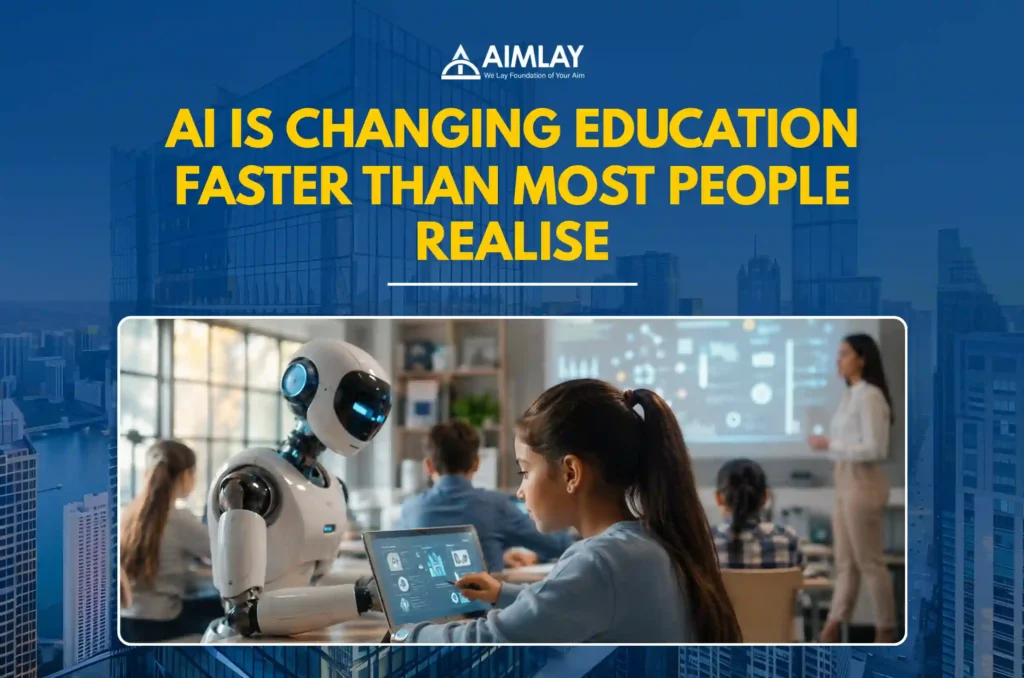
Most of the conversation regarding AI and Education is focused on the future. What will classrooms look like in 2030? Will teachers be replaced? In what way will students learn and ultimately teach themselves in new methods unrelated to the learning processes we have today?
Less often talked about is what is currently taking place, for example, in 2026 in actual schools with actual students and teachers.
AI transforming education has shifted from being a prediction, to an accurate depiction of the current educational landscape. However, the speed at which this transformation is occurring varies. Many institutions have been working toward this goal for years now; others view this as a “pilot.” Most students and educators fall somewhere in-between – they know that change is underway however they are unsure of the specifics of those changes or what they can or should do about them.
Table of Content
• How AI Is Changing Education Right Now
• How AI Is Transforming Classrooms
• AI Learning Tools Students Are Actually Using
• Benefits of AI in Education for Both Sides
• Personalized Learning with AI
• What This Means for Students and Educators in India
• Conclusion
• Frequently Asked Questions
How AI Is Changing Education Right Now
Where you look determines how much AI is affecting education. At the educational institution or university level, it is possible to see data-based instructional tools that are tracking student success from one cohort of students to another (ie. identify when students become disinterested), identify students who may be falling behind, and alter how courses are structured with regards to how students are progressing through content, as opposed to their grades at the end of a course.
At the individual student level, AI provides tools that provide students with instant explanations, practice questions designed to match a student’s current performance, writing feedback prior to the submission of an assignment to an instructor, and study plans that adjust based upon what a student has learned/retained versus what has not. None of these options were available at a large scale just 5 years ago.
The greatest difference lies in the rate at which these tools are being integrated into education. In 2026, AI will no longer exist solely within ed-tech start-ups; it exists today within the same technology that traditional mainstream institutions have always used: learning management systems, assessment tools, administrative software.
How AI Is Transforming Classrooms
What the future of the classroom looks like due to Artificial Intelligence (AI) isn’t so much a replacement for the classroom as it is a change in what goes on inside of it.
Once students receive immediate feedback from their learning, teachers will no longer need to devote large amounts of time to tasks that can be accomplished more quickly or efficiently by an artificial intelligence-based system. Teachers will be able to focus on those aspects of education that truly benefit from being done by people — such as facilitating discussions, mentoring students, and guiding students through problems or issues that don’t lend themselves to pre-determined types of questions. In this sense, AI for teachers is more about redistribution of time rather than pure automation. One area where educational institutions would clearly benefit from using AI-based systems is in handling the amount of administrative work required for teaching. For example, grading routine assessments, checking if student’s complete assignments on time, and identifying students who are falling behind in one subject or another, are all items that can be handled quicker and more accurately by systems designed specifically for that purpose.
AI Learning Tools Students Are Actually Using
AI learning tools being used by students at some scale in 2026 include, among others, AI-based writing assistants, adaptive practice platforms, intelligent tutoring systems, and AI-based search tools which provide explanations of an answer as opposed to just links.
A larger issue, however, is how AI powered learning will continue to alter the dynamic relationship of a student with respect to a particular challenging concept. As previously noted, traditional learning models ask students to have trouble with a concept or problem, become “stuck,” seek out resources (including classmates) to help them learn to solve it, and then attempt to do so again. The gap between being “stuck” and becoming “unstuck” may take days depending on when the next class is.
With AI for students, that gap collapses to minutes. A student working through a statistical concept at 11pm can get a worked example, a different explanation framed for their apparent level of understanding, and a practice problem in the time it would previously have taken to find a relevant textbook page.
| AI Tool Type | Primary Use | Who Benefits Most |
|---|---|---|
| Intelligent Tutoring Systems | Subject-Specific Adaptive Practice | Students in Technical or Analytical Subjects |
| Writing Feedback Tools | Draft Review Before Submission | Students Developing Academic Writing Skills |
| Adaptive Learning Technology | Personalized Pacing and Content Sequencing | Self-Paced and Distance Learners |
| AI Career Guidance | Course and Pathway Recommendations | Students Planning Postgraduate Study |
| Automated Assessment Tools | Routine Grading and Progress Tracking | Teachers Managing Large Cohorts |
Benefits of AI in Education for Both Sides
The advantages of using artificial intelligence (AI) in education are unevenly distributed, as should be said straight away. Those students who have consistent, fast Internet; devices capable of accessing the Internet; and sufficient knowledge about digital literacy will experience significant improvement. For those students who lack one or all of these, there will likely be less opportunity for growth and therefore potentially a widening gap between their classmates who can take advantage of this technology. This is essentially the access issue that is often overlooked when reporting on the positive effects of AI use within an educational setting.
To students who do have access to such resources and capabilities, AI can improve student learning mainly by providing immediate response and personalized instruction. The immediate response will prevent error from becoming habit-forming. By allowing each student to learn at his/her own pace, students will be able to focus more on areas where he/she has difficulty rather than attempting to cover material at the same rate.
The primary advantage of AI for educators is improved data quality. Educators utilizing data-based instructional tools gain insight into where their students’ actual abilities lie versus where they appear to be due solely to attendance records and test scores.
Personalized Learning with AI
Personalised learning with AI is one of the more substantive changes in how education is being delivered. Traditional classroom instruction is built around cohort averages. Content is paced for the middle of the distribution. Students above and below that middle are both underserved.
Adaptive learning technology changes this by adjusting the difficulty, type, and sequence of content based on how individual students are responding. A student who grasps a concept quickly moves on. A student who is struggling gets more time, a different explanation, or a more foundational review, depending on what the system identifies as the gap.
AI-driven education at this level is not a replacement for a teacher’s judgement. It is a supplement that handles the individualization that a single teacher managing thirty students cannot realistically provide. The combination of a teacher who knows their students and a system that tracks their progress in detail is more effective than either alone.
For students pursuing postgraduate or doctoral qualifications in India, platforms like Aimlay are incorporating guidance tools that help working professionals identify the right program pathway based on their academic background, professional goals, and timeline — a form of AI career guidance that reduces the guesswork in one of the more consequential academic decisions a professional will make.
What This Means for Students and Educators in India
The future of education with AI in India has a specific character. India’s higher education system is large, uneven in quality, and under significant pressure to scale access without a proportional increase in institutional capacity. Artificial intelligence in education offers one credible route to managing that pressure, particularly for distance and online programs where the student-to-faculty ratio makes individual attention genuinely difficult.
AI in education in 2026 in India is visible in the growth of adaptive learning platforms in edtech, the integration of AI tools into university LMS systems, and the increasing use of AI career guidance tools by students navigating the complex landscape of entrance exams, university rankings, and postgraduate options.
The pace will continue to increase. The institutions, educators, and students who engage with these changes as they happen rather than after the fact will be better positioned than those who wait for things to settle. They may be waiting a long time.
Conclusion
There is evidence already not just anticipation that artificial intelligence (AI) is impacting the way students learn and the way teachers teach. AI-based learning technologies, intelligent tutoring systems, personalized learning, and instant learning feedback are all changing student learning experiences, teacher instruction methods and institutional efforts to bridge the gap between the resources available for a student’s educational needs and the actual resources provided to meet those needs.
These impacts on education have been experienced differently by different stakeholders. Access issues remain. Not every application of an AI-driven education model has been well designed. However, the trend cannot be reversed and it is unlikely that this will slow. For both students and instructors interested in staying current with these trends, there is no longer a question as to whether or not AI-based learning tools impact teaching and learning. Rather, the question now becomes which one(s), utilized in what manner(s), with regard to what specific objectives?
Frequently Asked Questions
How is AI changing education in 2026 compared to a few years ago?
AI in education is now integrated into mainstream learning systems rather than being limited to specialized educational technology platforms. Schools and universities increasingly use AI for assessment tracking, personalized feedback, student progress monitoring, and learning support, making AI a standard part of the educational experience.
What are the main benefits of AI in education for students?
AI provides faster feedback, personalized learning experiences, adaptive content delivery, and additional learning support outside classroom hours. By identifying individual strengths and weaknesses, AI helps students focus on areas that need improvement, making learning more efficient and effective.
How are AI tools changing the role of teachers?
AI is helping teachers automate routine tasks such as grading, progress tracking, and identifying students who may need additional support. This allows educators to spend more time on teaching, mentoring, critical discussions, and providing personalized guidance that technology cannot replace.
What is an intelligent tutoring system and how does it work?
An Intelligent Tutoring System (ITS) is an AI-powered learning platform that provides personalized instruction and practice. It analyzes a student’s responses, identifies learning gaps, and adjusts lesson content and difficulty levels accordingly. These systems are commonly used in subjects such as mathematics, languages, and technical disciplines.
Is personalized learning with AI effective for all types of students?
AI-powered personalized learning is most effective for students who have reliable access to digital devices, internet connectivity, and basic digital literacy skills. When these conditions are met, adaptive learning technologies can improve learning outcomes by tailoring instruction and practice to individual needs.
How does AI career guidance help students making postgraduate decisions?
AI career guidance tools analyze factors such as academic background, career objectives, interests, and constraints to recommend suitable educational pathways and postgraduate programs. These tools can help students and working professionals make more informed decisions while reducing the time required to research available options.
