



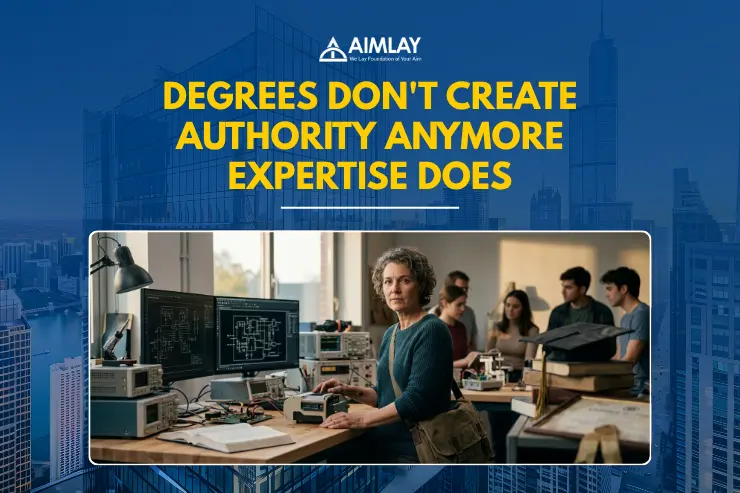
There was a time when a framed degree on the wall settled the argument. It told the room to listen to, who to hire, who to trust. That time has passed faster than most colleges want to admit.
Today, the person explaining machine learning on YouTube has 3 million subscribers and no formal CS background. The UX designer charging ₹80,000 per project learned everything through online courses and real client work. The marketing consultant for billing top-tier companies studied history in college. Expertise over certificates is no longer a contrarian idea; it is simply how the market works now.
Table of Content
• Why the Degree-Authority Link Broke
• What Expertise Actually Looks Like in 2026
• The Problem with Waiting for a Certificate
• Practical Experience Is the Differentiator
• Building Authority, The Right Way
• Frequently Asked Questions
Why the Degree-Authority Link Broke
For decades, a degree was a proxy. Employers couldn’t interview everyone, so they filtered by qualification. If you had the certificate, you cleared the first gate. The system worked because information was scarce. Getting deep knowledge in any field requires institutional access to libraries, labs, professors, and structured curricula.
That scarcity is gone. Deep, structured learning is now accessible to anyone with an internet connection and enough discipline to use it. The proxy no longer holds because the thing it was standing in for actual knowledge is no longer locked behind campus gates.
The result is a visible shift in how professional authority through experience gets built and recognized. Companies in high-growth sectors are dropping degree requirements for roles that once demanded them. What replaced the filter? Demonstrable skill. Portfolio. Track record. The ability to solve a real problem in a hiring conversation is important.
What Expertise Actually Looks Like in 2026
Expertise is not just knowledge. Anyone can memories facts. Real expertise shows up as pattern recognition the ability to read a situation, map it to experience, and make a call. It shows up at speed. An expert designer doesn’t just produce better work; they produce it faster with fewer revision cycles. It shows judgment knowing when a conventional approach will fail before testing it.
This is what career growth through skills actually means. It’s not about stacking credentials. It’s about building genuine capability that makes you faster, more accurate, and more valuable with every year of practice.
High-paying skills in today’s market data analysis, product management, full-stack development, content strategy, financial modelling, and digital advertising share one characteristic. They reward applications, not just comprehension. You can read about A/B testing for six months and still not understand it as well as someone who has run 40 experiments on a live product. The degree vs skills of debate, in these fields, resolves itself quickly in favor of the person with real work behind them.
The Problem with Waiting for a Certificate
Skill-based careers don’t wait. The market for practical experience moves in real time. While a three-year postgraduate program is underway, the tools it teaches may have already been revised, the companies it prepares you for may have changed their hiring criteria, and the peers who started learning independently may have two years of client work in their portfolios.
This isn’t an argument against education. Advanced degrees have clear value in specific fields of medicine, law, core engineering research, and academia. The problem is treating a degree as a substitute for capability instead of a complement to it. Authority through experience is built in the doing, not the waiting.
Real skills matter because the market tests them constantly. A degree is tested at the hiring gate. After that, you either perform or you don’t. Every person who has lasted in a demanding career knows this is true.
Practical Experience Is the Differentiator
Here’s what changes when you commit to expertise-first thinking: you stop asking “what qualification do I need?” and start asking “what can I actually do?”
That shift in question changes the path entirely. Learning becomes project-based, not module-based. You pick up skills because a real problem demands them, not because a syllabus includes them. You build a portfolio that shows output, not a transcript that shows attendance.
A career without a degree is not a compromise for those who couldn’t access higher education. In many skill-based careers today, it is a deliberate and well-reasoned choice. Some of the highest-earning professionals in Indian tech, design, content, and finance sectors have credentials that are secondary to what their work demonstrates.
The companies hiring them know this. The clients paying them know this. The only people who sometimes don’t know this are the ones still waiting to feel “qualified enough” before they start.
Building Authority, The Right Way
Expertise matters more than degrees in the long run, but expertise itself is not random. It is built deliberately: through consistent practice, real feedback, iterative improvement, and honest self-assessment about gaps.
If you are in a field where the gap between your current skills and your target role feels wide, structured guidance can accelerate the process significantly. Aimlay works with working professionals across India who are navigating this exact situation people who want to validate their expertise formally, upskill with direction, or move into research that deepens their authority in a specific domain.
The degree is a starting point for some, irrelevant to others. But expertise built through years of real work, applied knowledge, and skill-based careers is the thing that actually creates authority. Always has been. The market just took a while to catch up.
Frequently Asked Questions
Do degrees still matter in the job market?
Yes, degrees remain important in sectors such as government jobs, licensed professions, and traditional corporate roles. However, in fields like technology, digital marketing, design, and data analytics, practical skills and proven experience often carry greater weight than formal qualifications.
What are examples of high-paying skills that don’t require a degree?
Some high-demand skills include Full Stack Development, Data Science, UI/UX Design, Digital Marketing, SEO & Content Strategy, Financial Modeling, and Product Management. These careers often prioritize practical expertise and portfolio work over academic degrees.
How do I build career authority without a formal degree?
Focus on creating measurable results through projects, case studies, client work, published content, portfolios, and professional contributions. Building a strong public presence and demonstrating expertise can significantly enhance credibility.
Is a career without a degree sustainable long-term?
Yes. Professionals who continuously upgrade their skills, stay relevant to industry trends, and consistently deliver value can build successful and sustainable careers without a traditional degree.
What does expertise over certificates actually mean in practice?
It means employers increasingly evaluate your ability to solve problems and deliver results rather than focusing only on academic credentials. Portfolios, work samples, assessments, and real-world achievements often matter more than certificates.
How can Aimlay help working professionals validate their expertise?
Aimlay supports working professionals by providing guidance on academic pathways, research-oriented programs, and professional development opportunities that help recognize and formalize existing knowledge and industry experience.
