




With the increasing competition, it is crucial to choose the right undergraduate course to always be at the top. If you are a commerce student and planning a future in finance, then you should consider the BAF course. But what exactly does it mean, and is that the right choice for you? In this blog, we will understand why you should choose a BAF degree for career growth and financial stability.
Table of Content
• Bachelor of Accounting and Finance: Course Overview
• Bachelor of Accounting and Finance: Eligibility Criteria
• Bachelor of Accounting and Finance: Syllabus and Subjects
• Bachelor of Accounting and Finance: Admission Process
• Bachelor of Accounting and Finance: Careers and Salary in India
• Conclusion
• Frequently Asked Question
What is the BAF course?
The BAF full form is Bachelor of Accountancy and Finance, which is a 3-year undergraduate course for students who want to pursue a career in finance, accounting, banking, or a related field. After graduating with a BAF degree, you’ll have in-depth knowledge of accounting, taxation, finance, auditing, financial management, and business laws.
Bachelor of Accounting and Finance: Course Overview
| Particulars | Details |
|---|---|
| BAF Full Form | Bachelor of Accountancy and Finance |
| Course Level | Undergraduate |
| Duration | 3 Years (6 Semesters) |
| Eligibility | 10+2 from a recognized board (Commerce preferred) |
| Minimum Marks | 50%–60% (varies by college) |
| Admission Process | Merit-based / Entrance exam |
| Average Fees | ₹20,000 – ₹1,00,000 per year |
| Top Subjects | Accounting, Taxation, Auditing, Finance |
| Career Options | Accountant, Auditor, Financial Analyst |
| Higher Studies | MBA, M.Com, CA, CFA |
| Average Salary | ₹2.5 LPA – ₹5 LPA (freshers) |
Bachelor of Accounting and Finance: Eligibility Criteria
Before applying for the course, you must check the BAF eligibility criteria. Most universities follow a standard criterion for admission, but before applying, you must check it on the university’s official website to be sure. The general eligibility for the Bachelor of Finance and Accounting is as follows:
The students who are from a commerce background are generally preferred.
Students must have completed 10+2 from a recognized board such as CBSE, ICSE, or state boards.
Minimum percentage required is 50-60%. Top colleges may have higher cut-offs.
Some colleges take merit-based admissions, and some prefer entrance exams for admission.
It is important to check the eligibility from the University’s official website before applying for the BAF course.
Bachelor of Accounting and Finance: Syllabus and Subjects
The Bachelor of Accounting and Finance (BAF) syllabus is designed to help students have an in-depth knowledge of accounting, finance, taxation, and business management. The course is divided into 6 semesters over 3 years, with a mix of core and practical subjects.
| Year | Subjects |
|---|---|
| First Year | Financial Accounting – I & II, Business Communication – I & II, Economics – I (Micro) & II (Macro), Business Environment, Quantitative Methods, Foundation Course – I & II |
| Second Year | Financial Accounting – III & IV, Cost Accounting – I & II, Information Technology in Accounting, Business Law, Taxation – I & II, Auditing – I, Research Methods |
| Third Year | Financial Accounting – V & VI, Financial Management – I & II, Auditing – II, Direct Tax, Indirect Tax (GST), International Finance, Risk Management, Project Work/Dissertation |
Bachelor of Accounting and Finance: Admission Process
BAF course admission has a simple and student-friendly process, but it may vary depending on the university. Whether you’re applying for a private college or a top university, this step-by-step guide can help you understand the BAF admission process and secure a spot.
Step 1: Research and Shortlist
Start by researching and making a list of the universities that offer BAF courses. Then, to narrow down the list, compare factors like cost, location, placement opportunities, and other reputation factors. After finalizing your top university, move forward to the next step.
Step 2: Verify eligibility and fill out the form
Before applying, you must check the basic eligibility criteria to avoid rejection later. Fill out the admission form with the required details. Students need to apply through the official University website and avoid any third-party links.
Step 3: Check the admission process
Most colleges select students based on Class 12 marks, and cut-off lists are released by the colleges. Some universities conduct entrance exams, and students are shortlisted based on their scores. Keep an eye on the university’s website to check the merit cut-offs or entrance exam results.
Step 4: Pay the fees
The final step is to pay the semester/annual fees to confirm your admission. After completing the payment, you’ll receive a confirmation email. Make sure to avoid any third parties for fee payment and only pay the fees from the university’s website.
Bachelor of Accounting and Finance: Careers and Salary in India
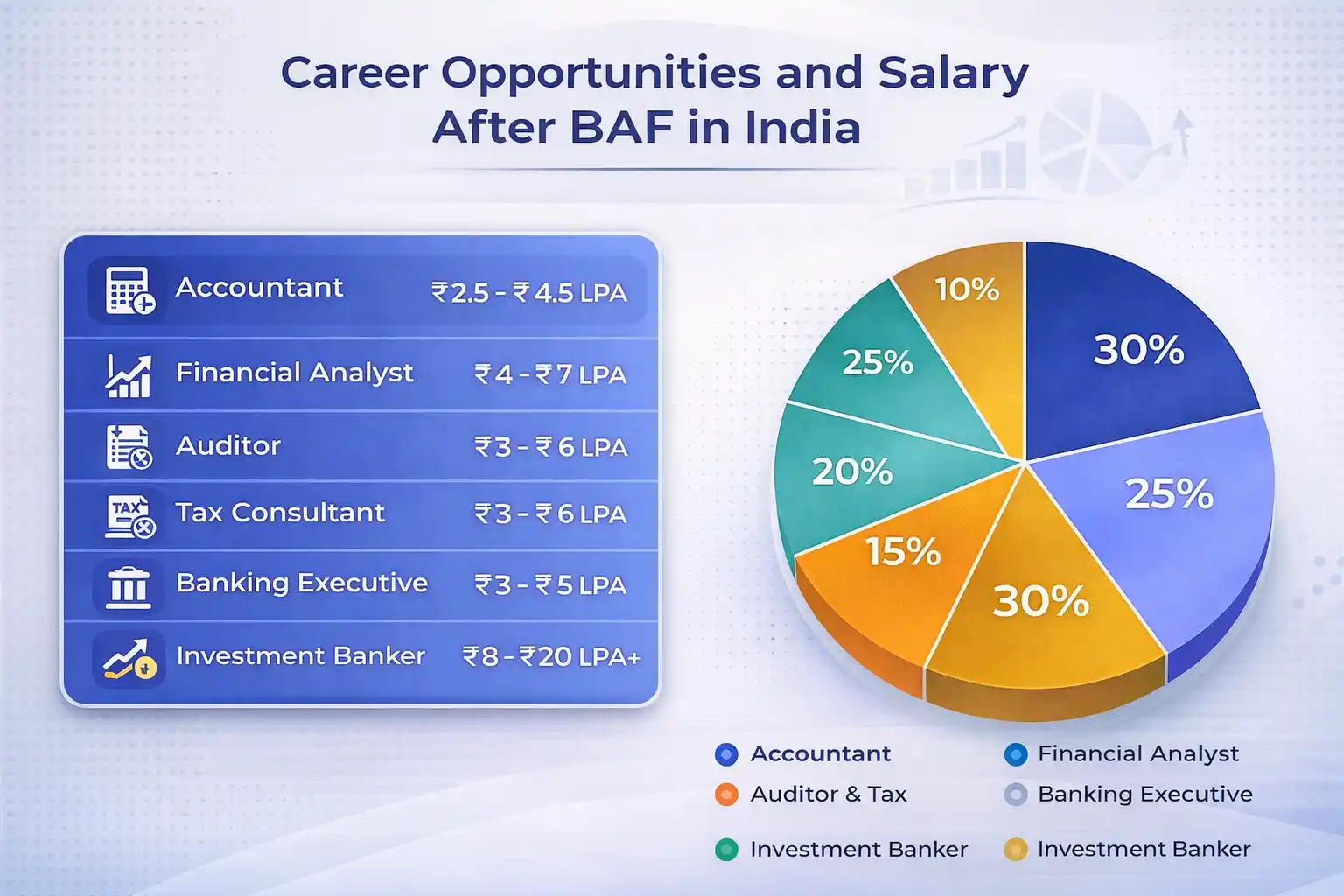
The Bachelor of Accounting and Finance is one of the most demanded undergraduate courses. It opens a wide range of opportunities in banking, finance, accounting, and corporate sectors. The following are the job roles that you can consider, and you can expect these salary ranges.
| Job Role | Average Salary (India) |
|---|---|
| Accountant | ₹2.5 – ₹4.5 LPA |
| Financial Analyst | ₹4 – ₹7 LPA |
| Auditor | ₹3 – ₹6 LPA |
| Tax Consultant | ₹3 – ₹6 LPA |
| Banking Executive | ₹3 – ₹5 LPA |
| Investment Banker | ₹8 – ₹20 LPA+ |
BAF graduates are in demand across various sectors:
• Banking and Financial Services
• Corporate Companies
• Audit and Consultancy Firms
• Insurance Sector
• Government Organizations
Several factors affect your salary after completing your Bachelor of Accounting and Finance degree. The factors include skills and knowledge, company size and reputation, location, and work experience. To boost your earning potential after completing your BAF course, you must consider pursuing professional courses like CFA, CA, or MBA. Gaining practical experience through internships will be an added advantage.
Conclusion
If you aim to build a successful career in finance, accounting, or banking, the BAF course can be a powerful stepping stone toward your goals. The Bachelor of Accountancy and Finance is a highly valuable degree for students interested in finance and accounting careers. With a well-structured curriculum, strong career scope, and opportunities for higher studies, the BAF course is an excellent choice for commerce students.
Whether you aim to become a financial expert, work in banking, or pursue professional certifications, the BAF degree can serve as a solid foundation for your future.
Frequently Asked Questions
What is the BAF course?
BAF (Bachelor of Accounting and Finance) is a three-year undergraduate course that provides in-depth knowledge in accounting, taxation, finance, auditing, and related fields.
Can I pursue CA after BAF?
Yes, you can pursue Chartered Accountancy (CA) after completing your BAF degree, and it is one of the most popular career paths among BAF graduates.
What is the difference between BAF and B.Com?
Both courses are suitable for commerce students. BAF is a specialized course focusing on accounting, taxation, and finance, whereas B.Com is a broader program covering business, economics, and management subjects.
What are the career options after the BAF course?
Top career options after BAF include Accountant, Financial Analyst, Auditor, Tax Consultant, and Banking Professional roles across various industries.
Can I do BAF without math?
Yes, many colleges offer BAF admission without mathematics as a mandatory subject. However, having basic numerical and analytical skills is important for understanding the course effectively.
